Sunday, June 6, 2021

Why I spoke out against lockdowns

undefined

I had no choice but to speak out against lockdowns. As a public-health scientist with decades of experience working on infectious-disease outbreaks, I couldn’t stay silent. Not when basic principles of public health are thrown out of the window. Not when the working class is thrown under the bus. Not when lockdown opponents were thrown to the wolves. There was never a scientific consensus for lockdowns. That balloon had to be popped.

Two key Covid facts were quickly obvious to me. First, with the early outbreaks in Italy and Iran, this was a severe pandemic that would eventually spread to the rest of the world, resulting in many deaths. That made me nervous. Second, based on the data from Wuhan, in China, there was a dramatic difference in mortality by age, with over a thousand-fold difference between the young and the old. That was a huge relief. I am a single father with a teenager and five-year-old twins. Like most parents, I care more about my children than myself. Unlike the 1918 Spanish Flu pandemic, children had much less to fear from Covid than from annual influenza or traffic accidents. They could get on with life unharmed — or so I thought.

For society at large, the conclusion was obvious. We had to protect older, high-risk people while younger low-risk adults kept society moving.

But that didn’t happen. Instead, schools closed while nursing homes went unprotected. Why? It made no sense. So, I picked up a pen. To my surprise, I could not interest any US media in my thoughts, despite my knowledge and experience with infectious-disease outbreaks. I had more success in my native Sweden, with op-eds in the major daily newspapers, and, eventually, a piece in spiked. Other like-minded scientists faced similar hurdles.

Instead of understanding the pandemic, we were encouraged to fear it. Instead of life, we got lockdowns and death. We got delayed cancer diagnoses, worse cardiovascular-disease outcomes, deteriorating mental health, and a lot more collateral public-health damage from lockdown. Children, the elderly and the working class were the hardest hit by what can only be described as the biggest public-health fiasco in history.

Throughout the 2020 spring wave, Sweden kept daycare and schools open for every one of its 1.8million children aged between one and 15. And it did so without subjecting them to testing, masks, physical barriers or social distancing. This policy led to precisely zero Covid deaths in that age group, while teachers had a Covid risk similar to the average of other professions. The Swedish Public Health Agency reported these facts in mid-June, but in the US lockdown proponents still pushed for school closures.

In July, the New England Journal of Medicine published an article on ‘reopening primary schools during the pandemic’. Shockingly, it did not even mention the evidence from the only major Western country that kept schools open throughout the pandemic. That is like evaluating a new drug while ignoring data from the placebo control group.

With difficulty publishing, I decided to use my mostly dormant Twitter account to get the word out. I searched for tweets about schools and replied with a link to the Swedish study. A few of these replies were retweeted, which gave the Swedish data some attention. It also led to an invitation to write for the Spectator. In August, I finally broke into the US media with a CNN op-ed against school closures. I know Spanish, so I wrote a piece for CNN-EspaƱol. CNN-English was not interested.

Something was clearly amiss with the media. Among infectious-disease epidemiology colleagues that I know, most favour focused protection of high-risk groups instead of lockdowns, but the media made it sound like there was a scientific consensus for general lockdowns.

Fair Use Excerpt. Read the rest here.

from Why I spoke out against lockdowns

Del Bigtree’s Ron Paul Interview: Coronavirus Crackdowns and Vaccines, Inflation, the Great Reset, Libertarianism, and More

In the Thursday episode of The HighWire, host Del Bigtree has brought us a standout interview with premier libertarian communicator Ron Paul. The just over one-hour wide-ranging interview is among Paul’s more informative and fascinating interviews from his decades of promoting libertarian ideas. Starting off with a discussion of libertarianism, the interview then proceeds to discussion of several other matters including inflation, the Great Reset scheme for suppressing people across the...

Read the full report by clicking the title, below...


from Peace and Prosperity http://www.ronpaulinstitute.org/archives/peace-and-prosperity/2021/june/06/del-bigtree-s-ron-paul-interview-coronavirus-crackdowns-and-vaccines-inflation-the-great-reset-libertarianism-and-more/

Saturday, June 5, 2021

'Unloading A Revolver Into The Head Of Any White Person': Yale Features Violent, Racist Diatribe By Psychiatrist

undefined

We previously discussed the ongoing controversies over former Yale psychiatrist Dr. Bandy Lee, who made highly unprofessional and sensational remarks throughout the Trump presidency. The school eventually got rid of Lee but seems to have found another even more controversial substitute as a speaker in psychiatrist Dr. Aruna Khilanani. The New York-based doctor was invited to Yale School of Medicine in April to deliver an address which turned out to be a violent, racist diatribe, including saying that she often thought of “unloading a revolver into the head of any white person that got in my way.”

The audio of the talk was placed on substack by former New York Times opinion writer and editor Bari Weiss. Khilanani previously complained that Yale had restricted access to her speech and demanded that it be made public. Yale Child Study Center Director of Medical Studies Dr. Andres Martin was listed as “course director” for the talk.

Khilanani launched into an attack of all white people as a monolithically ignorant, delusional, and hateful group. Early on, she offers a telling self-diagnosis: “We are calm, we are giving, too giving, and then when we get angry, they use our responses as confirmation that we’re crazy or have emotional problems.” She insisted “Nothing makes me angrier than a white person who tells me not to be angry, because they have not seen real anger yet.”

Khilanani then gives a chilling observation. After noting that she stopped watching news because it upset her too much, she noted “I had fantasies of unloading a revolver into the head of any white person that got in my way, burying their body and wiping my bloody hands as I walked away relatively guiltless with a bounce in my step. Like I did the world a f–king favor.”

Khilanani encouraged the audience to stop speaking with white people because they are incapable of dealing with their racism and refuse to admit that they are all racists.
White people are out of their minds, and they have been for a long time … White people feel that we are bullying them when we bring up race. They feel that we should be thanking them for all that they have done for us. They are confused, and so are we. . . We keep forgetting that directly talking about race is a waste of our breath. We are asking a demented, violent predator who thinks that they are a saint or a superhero to accept responsibility. It ain’t gonna happen…They have five holes in their brain. It’s like banging your head against a brick wall.
Khilanani was brought in by Yale to share her thoughts on “decoding white people” and explain how white people are useless to speak to (despite the white people in her audience).

Khilanani is an example of a growing number of writers and academics spewing anti-white sentiments while dismissing any criticism as white insecurity or privilege. Elie Mystal, writer for Above the Law and The Nation’s justice correspondent, for example, lashed out at “white society” and how he strived to maintain a “whiteness free” life in the pandemic. A seminary professor recently publicly prayed “Dear God, Please help me to hate White people” and to overcome any lingering concern for them. Even students are voicing such views. We recently discussed a Miami law student writing about her “hate for white people.” It is not hard to imagine what would be the response if such statements were made about a different race.

I have long defended such statements as protected by free speech principles and I feel the same way about Khilanani’s speech. This is a viewpoint that should be discussed and debated. In the past, I have defended extremist views on academic freedom grounds like those of University of Rhode Island professor Erik Loomis, who has defended the murder of a conservative protester and said that he saw “nothing wrong” with such acts of violence. (Loomis also writes for the site “Lawyers, Guns, and Money.”) I have defended faculty who have made similarly disturbing comments “detonating white people,” denouncing police, calling for Republicans to suffer, strangling police officers, celebrating the death of conservatives, calling for the killing of Trump supporters, supporting the murder of conservative protesters and other outrageous statements.

I believe in largely unfettered free speech, particularly for statements made off campus or outside of a classroom. There is a value to having an open intellectual forum including extremist views like those of Loomis and Khilanani. The problem is that universities have shown little tolerance for opposing viewpoints and have often subjected faculty to investigations and sanctions for expressing their viewpoints. Students have also been sanctioned for criticism BLM and anti-police views at various colleges. Even a high school principal was fired for stating that “all lives matter.” Each of these controversies raise concerns over the countervailing statements against police or Republicans or other groups.

The problem is not the tolerance shown speakers like Khilanani but the intolerance shown opposing viewpoints. Indeed, it is rare for such conservative or libertarian speakers to be invited to these conferences or campus events. Yale clearly wanted to feature Khilanani and her “decoding whiteness” viewpoints. The question is whether it will now offer a speaker who will decode Khilanani and whether she is herself an example of violent and racist ideations.

Reprinted with permission from JonathanTurley.org.

from 'Unloading A Revolver Into The Head Of Any White Person': Yale Features Violent, Racist Diatribe By Psychiatrist

Thursday, June 3, 2021

A Libertarian Look At Land, Fear, And Life After Covid. With Guest Jeff Deist.

Mises Institute president and former Rep. Ron Paul chief-of-staff Jeff Deist joins today's Liberty Report to discuss the prospects for libertarianism and a non-violent approach to seemingly intractable disputes over land, control, and government coercion. Is the post-Covid US ripe or barren for the ideas of liberty to take hold? Watch today's Liberty Report:


from A Libertarian Look At Land, Fear, And Life After Covid. With Guest Jeff Deist.

COVID-19 Vaccine Status a Private Affair

undefined

A poll from Morning Consult earlier this month found that vaccinated Americans are more afraid than the unvaccinated to eat inside a restaurant, travel outside the United States or go to the gym to work out — an astonishing discovery given that the whole reason for getting the vaccine is, drumroll, please, to prevent getting COVID-19.

But this poll explains a lot.

Like why perfect strangers think it’s A-OK to ask if you’ve had a vaccine, if you are planning to get the vaccine, and if not, why not. They’re not at all polite about it, either.

“It is ethical to ask if someone is vaccinated?” The Philadelphia Inquirer inquired. “That would be a hard no, says Sally Scholz, chair and professor of philosophy at Villanova University. … This is a medical issue and, ethically, it’s never OK to ask someone about their health status; in essence, you are asking someone to divulge sensitive information about their medical history that they may be uncomfortable sharing.”

Quite right.

And yet.

And yet that’s a truth that’s being rapidly pushed to the side in this brave new coronavirus world.

Remember the days when personal medical and health decisions stayed personal?

The coronavirus has changed all that. Fear and ignorance driven by a politically exploitative class of political exploiters have changed all that. How else to explain the poll findings of the very class of people who are supposed to be safe from catching the coronavirus, who the scientists said would be safe from catching the coronavirus — that these people are the very ones afraid to do anything? Even worse are the vaccinated who still doggedly insist on wearing face masks — along with you and your dog, Toto, too. Meanwhile, it’s the supposed “unsafe” — the unvaccinated — who want nothing more than to get back to living, and who are, in fact, following that desire with real action.

“Unvaccinated respondents,” Morning Consult wrote in early May, “were more than twice as likely as vaccinated people to feel comfortable traveling abroad or going on a cruise given the state of the pandemic. Other activities that unvaccinated people were significantly more open to included dating, attending a work conference, going to a gym or exercise class, riding on a train or bus and visiting an amusement park.”

Why bother getting the vaccine then?

That’s a good question. And the answer has nothing to do with science or medical truth. It has to do with fear. It has to do, too, with feel-good virtue signaling and the chance to wallow in some good old-fashioned self-righteous indignation.

“As we rush to reconnect,” wrote one at The Philadelphia Inquirer, “I want to know people’s vaccination status. I know. I know. I’m being overly cautious. … [But] the only way I’m going to feel comfortable socializing in intimate settings is if my peeps are vaccinated.”

This is the mark of the modern-day self-righteous beast, the one that says, “I know better than you what’s right for you.” The one that says, “You’re making me feel uncomfortable so it’s up to you to change so I feel comfortable.”

The one that says America’s rapidly moving from a nation of independent individualism to a country of communist collectivism. After all, this is how fascists and socialists and communists think: that the word “I” should be obliterated from the world’s dictionaries.

There’s no “I.” There’s only “we.”

And the train of thought as it relates to this coronavirus and to America’s response to the coronavirus and vaccine goes like this: Because there’s no “I,” there’s only “we,” and because the health decisions of one are only seen through the filter of how they affect the health of the many, then it’s completely natural, logical, acceptable and even expected to ask about vaccination status.

It’s natural, logical, acceptable and even expected to downright demand those who’ve not taken the vaccine to take it. 

So. Before you ask, consider what it is you’re really asking — and why. Chances are, in a country like America where individualism includes informed consent and the right to choose one’s own health decisions, it’s really none of your business in the first place.

Reprinted with author's permission from Washington Times.

from COVID-19 Vaccine Status a Private Affair

The New Domestic War on Terror Has Already Begun -- Even Without the New Laws Biden Wants

undefined

The Department of Homeland Security on Friday issued a new warning bulletin, alerting Americans that domestic extremists may well use violence on the 100th Anniversary of the Tulsa race massacre. This was at least the fourth such bulletin issued this year by Homeland Security (DHS) warning of the same danger and, thus far, none of the fears it is trying to instill into the American population has materialized.

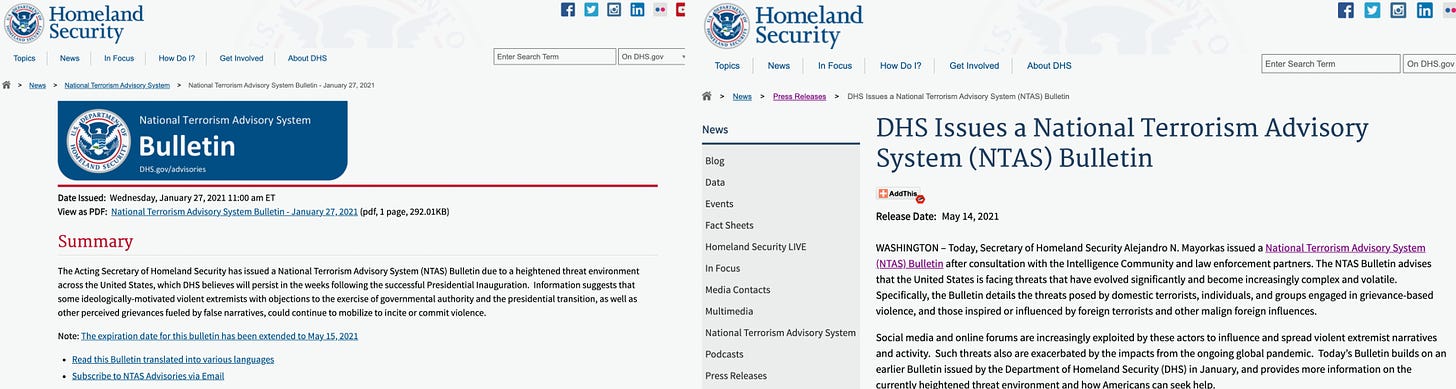
The first was a January 14 warning, from numerous federal agencies including DHS, about violence in Washington, DC and all fifty state capitols that was likely to explode in protest of Inauguration Day (a threat which did not materialize). Then came a January 27 bulletin warning of “a heightened threat environment across the United States that is likely to persist over the coming weeks” from “ideologically-motivated violent extremists with objections to the exercise of governmental authority” (that warning also was not realized). Then there was a May 14 bulletin warning of right-wing violence “to attack higher-capacity targets,” exacerbated by the lifting of COVID lockdowns (which also never happened). And now we are treated to this new DHS warning about domestic extremists preparing violent attacks over Tulsa (it remains to be seen if a DHS fear is finally realized).

Just like the first War on Terror, these threats are issued with virtually no specificity. They are just generalized warnings designed to put people in fear about their fellow citizens and to justify aggressive deployment of military and law enforcement officers in Washington, D.C. and throughout the country. A CNN article which wildly hyped the latest danger bulletin about domestic extremists at Tulsa had to be edited with what the cable network, in an “update,” called “the additional information from the Department of Homeland Security that there is no specific or credible threats at this time.” And the supposed dangers from domestic extremists on Inauguration Day was such a flop that even The Washington Post — one of the outlets most vocal about lurking national security dangers in general and this one in particular — had to explicitly acknowledge the failure:
Thousands [of National Guard troops] had been deployed to capitals across the country late last week, ahead of a weekend in which potentially violent demonstrations were predicted by the FBI — but never materialized.

Once again on Wednesday, security officials’ worst fears weren’t borne out: In some states, it was close to business as usual. In others, demonstrations were small and peaceful, with only occasional tense moments.
Americans have seen this scam before. Throughout the first War on Terror, DHS, which was created in 2002, was frequently used to keep fear levels high and thus foster support for draconian government powers of spying, detention, and war. Even prior to the Department's creation, its first Secretary, Tom Ridge, when he was still the White House's Homeland Security Chief in early 2002, created an elaborate color-coded warning system to supply a constant alert to Americans about the evolving threat levels they faced from Islamic extremists.

undefined
DHS Bulletin on domestic extremists, Jan. 27, 2021; DHS Bulletin on domestic extremists, May 14, 2021.
(Bigger)


In 2004, Ridge admitted that he had been repeatedly pressured by Bush officials to elevate the warnings and threat levels for political gain and to keep the population in fear. He claims that he, in particular, was coerced against his will to raise the threat level just prior to the 2004 presidential election and resigned for that reason shortly thereafter. DHS's color scheme became "the brunt of endless jokes and derision,” concluded a 2007 scholarly study in the journal International Security, noting that it "became perceived as being politically motivated” largely due to the complete lack of specific information about what Americans were supposed to fear or avoid. Moreover, “its designers assumed that the population would trust in the national leadership and believe in the utility of the system's information.” It failed because of how often the alleged threats failed to materialize, and because the warnings were rarely accompanied by any specificity that could permit action to be taken or avoided.

Though Obama scrapped the unpopular color-coded system in 2011, he — in a classic Obama gesture — merely replaced it with an equally vague and fear-generating bureaucratic alternative that was also subject to political manipulation. National security writers at Lawfare ultimately acknowledged that “like the [Bush/Ridge] system, there were no clear triggers for alerts [under Obama's new scheme,] so the system remained objective and opaque.” As a result, they said, “the lack of specificity over time has resulted in similar levels of confusion as surrounded the [Bush/Ridge] color alerts.”

Fear is crucial for state authority. When the population is filled with it, they will acquiesce to virtually any power the government seeks to acquire in the name of keeping them safe. But when fear is lacking, citizens will crave liberty more than control, and that is when they question official claims and actions. When that starts to happen, when the public feels too secure, institutions of authority will reflexively find new ways to ensure they stay engulfed by fear and thus quiescent.

I saw first-hand how this dynamic functions when doing the Snowden-enabled reporting on mass domestic NSA surveillance under the Obama administration. By the time we broke the stories of mass domestic surveillance on Americans — twelve years after the 9/11 attack — fear levels over Al Qaeda in the U.S. had diminished greatly, especially after the 2011 killing of Osama bin Laden. As a result, anger over Obama's sprawling domestic surveillance programs was pervasive and bipartisan. A bill jointly sponsored by then-Rep. Justin Amash (R-MI) and Rep. John Conyers (D-MI) — which would have greatly reined in NSA domestic spying powers — was on its way to easy, bipartisan victory as a result of that anger over NSA spying. But suddenly, the Obama White House convinced Nancy Pelosi to whip enough Democratic votes to ensure its defeat and save NSA domestic spying from reform. But the momentum which that bill had — it would have been the first since 9/11 to rollback rather than expand government powers — along with anti-surveillance-and-pro-privacy polling data, proved how significantly the playing field had shifted as a result of those revelations and, especially, the reduction in fear levels experienced by Americans.

But shortly thereafter, a new group — ISIS — emerged to replace Al Qaeda. It had a two-year stint with middling success in scaring Americans, but it was sufficient to turn back the tide of pro-privacy sentiment (at one point in 2014, the U.S. intelligence community claimed out of nowhere that a Syria-based group that virtually nobody in the U.S. had ever heard of previously or since — "the Khorasan Group" — was “a more direct and imminent threat to the United States,” but that new villain disappeared as quickly as it materialized). After ISIS’s star turn in the role of existential threat, the Democrats, during the 2016 campaign, elevated Russia, Putin and the Kremlin to that role, abandoning without explanation Obama's eight-year argument that Russia was merely a regional power of no threat to the U.S. This revolving carousel of scary villains ensured that the pressure to reduce the powers and secrecy of the U.S. security state eroded in the name of staying safe.

Fair Use Excerpt. Read the whole article here.

from The New Domestic War on Terror Has Already Begun -- Even Without the New Laws Biden Wants