NATO has chosen to launch war games near Russia's border precisely when the US and UK are sending longer range multiple rocket launchers to Ukraine and when the Russian president has warned that any rockets hitting Russia would incur a big response. What's the game here? Bigger war? Also today: Read-out from the big RPI conference on Saturday and more. Watch today's Liberty Report:
from NATO Launches Big Baltic War Games...What Could Go Wrong?
Monday, June 6, 2022
How Russia Can (And Will?) De-NATO-ize Europe

In a video published yesterday Gonzalo Lire, currently under house arrest in Karkov, is asking a very interesting question:
What Happens To Europe When Russia Wins? (vid)
Lira states, and I agree with him, that Russia will win the war in the Ukraine, take the south and east to likely create a new country and leave the rest of the cadaver for Poland, Hungary, Romania, Lithuania and others to feast on.
But then what?
The US controlled NATO will still be there. It is practically guaranteed that the US will use it to push for revenge for the loss of Ukraine. This will be done by a steady buildup of troops and long range missile capabilities along Russia's Nordic and Baltic borders and additional naval threats in the northern Arctic as well as the southern Black Sea. Some ten years from now the US would be able to again try to wage a big (proxy) war against Russia. Then with a decent chance to win.
No negotiations or peace agreements will prevent that. The US is famously non-agreement-capable (недоговороспособны). It has broken ALL promises and agreements it has ever made with Russia.
Dozens of US and European luminaries had promised to Russia that NATO would expand 'not one inch' towards Russia. Look where its borders are now. The US and the EU have confiscated huge amounts of Russian state owned money. They have even taken, in contradiction to their own constitutions, the properties of private Russian citizens just because those persons happen to be Russian.
In 2014 Germany and France signed on to guarantee elections for a peaceful regime change in Kiev. A day later the fascists stormed the Ukrainian parliament and those guarantees turned out to be totally worthless. The US simply said fuck the EU. It does not give shit about European interests. Germany and France later negotiated and signed the Minsk-1 and Minsk-2 agreements. They continued to feed billions of EU money into Ukraine even as the Ukrainian government, controlled by the US, did nothing to fulfill them. Yes, they were that stupid.
The US has installed 'missile defense' systems in Poland and Romania which are in fact designed to lob Intermediate Range Ballistic Missiles (IRBM) onto Moscow. These are a serious danger to Russia.
Even after Ukraine is finished, NATO and its EU proxies will continue to be a danger to Russia. Both have proven to be unable to keep promises. Russia in consequence will have to rearrange them.
Russia could do that by force. But there will be no march towards Riga, Warsaw, Berlin or Paris. (Remember that Russia has been there and done that which every time has led to major changes in Europe.)
Russia has announced its strategic aims. In December 2021 Russia set forth two agreements which the US and NATO. They included demands for a future arrangement in Europe that would guarantee indivisible security for all. On January 21 2022 the Russian Foreign Minister Sergei Lavrov was to meet Secretary of State Anthony Blinken in Geneva to talk about Russia's proposals. Just minutes before that meeting the Foreign Ministry of Russia held a news conference to answer media questions:
Question: What will Russia’s demand that NATO return to the 1997 framework mean for Bulgaria and Romania? Will they have to leave NATO, remove US bases from their territory, or something else?Reuters reported:
Answer: You mentioned one of the cornerstones of Russia’s initiatives. It was deliberately set forth with utmost clarity to avoid any ambiguity. We are talking about the withdrawal of foreign forces, equipment, and weapons, as well as taking other steps to return to the set-up we had in 1997 in non-NATO countries. This includes Bulgaria and Romania.
MOSCOW (Reuters) - The security guarantees that Russia seeks from the West include provisions requiring NATO forces to leave Romania and Bulgaria, the Russian foreign ministry said on Friday.After more than 20 years of watching Lavrov and Putin everyone should know that they do not publicly set out aims if they have no way to achieve them. They always have well thought out plans before announcing their goals.
Moscow has demanded legally binding guarantees from NATO that the bloc will stop its expansion and return to its 1997 borders.
Replying to a question about what that would mean for Bulgaria and Romania, which joined NATO after 1997, the ministry said Russia wanted all foreign troops, weapons and other military hardware withdrawn from those countries.
So how can Russia actually achieve a retreat of NATO back to its 1997 borders?
Sanctions. The US has used its economic and military powers to sanction this or that country that did not do as it was told to do by Washington. Unless enacted by the UN Security Council such sanctions have no basis in international law. Despite that the US even used secondary sanctions. It threatened sanctions against Europe, and everyone else, as it ordered them to not deal with Iran or Venezuela.
The US is thinking about "allowing" Europe and Venezuela to trade together. Think about what this story tells us about global power relations and who is in charge.The US is thinking about "allowing" Europe and Venezuela to trade together.
— Alan MacLeod (@AlanRMacLeod) June 6, 2022
Think about what this story tells us about global power relations and who is in charge. https://t.co/FD7vnWW58E
Russia can do similar. But as it always follows international law, it will have to do it in a slightly different way.The US could allow Eni and Repsol to ship Venezuelan oil to Europe as soon as July to make up for Russian crude, Reuters reported https://t.co/4dddQc8iM2
— Bloomberg (@business) June 5, 2022
Russia is a superpower in that it produces all kinds of raw materials the world, and especially the 'west', needs. Europe, and especially Germany, is depending on natural gas and oil from Russia. Energy prices in Germany will at least triple if it is completely cut off from Russian supplies.
German industry leader have loudly announced that they will have to close shop if the current European policies of restricting Russian energy supplies continues. The chemical giants BASF and Bayer will have to move to some other country. Volkswagen, Mercedes, BMW will have to stop all production in Europe. Steel production would fall to zero. Lack of fertilizer would lead to dependency on foreign agriculture.
Mass unemployment would follow. Millions will be in the street to protest against rolling blackouts, freezing apartments and hyperinflation.
Russia can achieve this at any time. It simply has to stop supplying gas and oil to Europe.
Despite six European 'sanction packages' against Russia there has yet to be a reciprocal response from Russia. It may still hope that European leaders will recognized the deadly game the US is playing with them.
Unfortunately the leaders of Europe are dumb and compromised. The 'olive green' German Minister for Economic Destruction Robert Habeck still dreams of bringing Russia's economy to its knees even as the ruble rises and Germany's economy is falling apart. Chancellor Olaf Scholz was never the brightest bulb in the room. He is deeply compromised through his involvement in the Wireguard scandal. He was the Minister of Finance when reports of the company's billion dollar fraud were suppressed by his ministry. And don't get me going about Ursula van der Leyen who has been proven to be corrupt and incompetent ever since she took her first public office. US secret services will know of many other crimes these people have been involved in.
The current ideological leaders of Europe will have to be replaced by clean ones who follow the German tradition of Realpolitik:
Realpolitik (German: [ʁeˈaːlpoliˌtiːk]; from German real 'realistic, practical, actual', and Politik 'politics'), refers to enacting or engaging in diplomatic or political policies based primarily on considerations of given circumstances and factors, rather than strictly binding itself to explicit ideological notions or moral and ethical premises. In this respect, it shares aspects of its philosophical approach with those of realism and pragmatism. It is often simply referred to as "pragmatism" in politics, e.g. "pursuing pragmatic policies" or "realistic policies".Only with new and decent leaders will Europe come to its senses.
Russia can help to achieve that while at the same time solving its NATO problem.
It can publicly declare that:
THERE WILL BE NO FURTHER RUSSIAN SUPPLIES OF ANY KIND TO EUROPE UNTIL IT BREAKS WITH WASHINGTON.
What would follow?
Millions of discussions under candlelight would be held in freezing and hungry European households. Political opinions would change. Governments would be replaced with more pragmatic ones.
France and Germany would either have to leave NATO or become impoverished and irrelevant. US troops on European grounds would be asked to leave or be attacked and thrown out by an enraged public. Germany would prohibit the US military from using its airspace. The U.S would lose its grip over the continent.
That can't happen? Well, Gonzalo Lira disagrees and so do I. In early February, before the Russian intervention in Ukraine, I had warned of the consequences of current 'western' policies:
The US strategy to 'fix' Russia in Europe by imposing 'crushing sanctions' on it to then attack China is failing. That is because it was completely misconceived.The consequences for Europe were obvious:
Russia is the most autarkic country in the world. It produces nearly everything it needs and has highly desirable products that are in global demand and are especially needed in Europe. Russia also has huge financial reserves. A sanctions strategy against Russia can not work.
The US and its proxies in the EU and elsewhere have put up very harsh sanctions on Russia to damage its economy.Europe is fortunate in that Russia, even before re-entering the Ukraine, has offered a very decent alternative to US hegemony in Europe:
The final intent of this economic war is regime change in Russia.
The likely consequence will be regime change in many other countries.
...
All energy consumption in the US and EU will now come at a premium price. This will push the EU and the US into a recession. As Russia will increase the prices for exports of goods in which it has market power - gas, oil, wheat, potassium, titanium, aluminum, palladium, neon etc - the rise in inflation all around the world will become significant.
...
[Russia and China] have spent more brain time on the issue than the US has.
The Europeans should have acknowledged that instead of helping the US to keep up its self-image of a unipolar power.
It will take some time for the new economic realities to settle in. They will likely change the current view of Europe's real strategic interests.
A man who has Putin's ear, Professor Sergey Karaganov who is the honorary chairman of Russia’s Council on Foreign and Defense Policy, has written an op-ed that points to an alternative.That last paragraph is the gist of Russia's real strategic aims. They require to destroy the current system of US hegemony over Europe. Europe will have to be de-NATO-sized. Regime changes in European countries will probably be necessary to see to that.
The piece was requested by and supposed to be published in the Financial Times, which means that it is directed at the European leadership. But the FT has now rejected it for unstated reasons. It was then published in the Russia in Global Affairs journal and has now been re-published by RT.
...
[Karaganov] states:The security system in Europe, built largely by the West after the 1990s, without a peace treaty having been signed after the end of the previous Cold War, is dangerously unsustainable.
There are a few ways to solve the narrow Ukrainian problem, such as its return to permanent neutrality, or legal guarantees from several key NATO countries not to ever vote for further expansion of the bloc. Diplomats, I assume, have a few others up their sleeves. We do not want to humiliate Brussels by insisting on repudiating its erroneous plea for the open-ended expansion of NATO. We all know the end of the Versailles humiliation. And, of course, the implementation of the Minsk agreements.
But the task is wider: to build a viable system on the ruins of the present. And without resorting to arms, of course. Probably in the wider Greater Eurasian framework. Russia needs a safe and friendly Western flank in the competition of the future. Europe without Russia or even against it has been rapidly losing its international clout. That was predicted by many people in the 1990s, when Russia offered to integrate with, not in, the continent’s systems. We are too big and proud to be absorbed. Our pitch was rejected then, but there is always a chance it won’t be this time.
Russia's leaders now have a once in a century chance to achieve those aims. They will be condemned by their compatriots if the refrain from doing so. The US has no way to prevent or counter a Russian sales boycott and its consequences.
When will European politicians, or those behind them, finally wake up to those facts?
Update (11:45 UTC):
A soundbite from a press conference Lavrov is currently holding:
Russian Embassy, UK @RussianEmbassy - 11:41 UTC · Jun 6, 2022
FM #Lavrov: To all appearances, no one is going to even reform #NATO. They are going to turn this “defensive alliance” into a global alliance claiming global military dominance. This is a dangerous path that is definitely doomed to failure.
Reprinted with permission from Moon of Alabama.FM #Lavrov: To all appearances, no one is going to even reform #NATO. They are going to turn this “defensive alliance” into a global alliance claiming global military dominance. This is a dangerous path that is definitely doomed to failure. pic.twitter.com/gMGvn8gvsK
— Russian Embassy, UK (@RussianEmbassy) June 6, 2022
from How Russia Can (And Will?) De-NATO-ize Europe

Guarding Democracy From News

The past month has seen blows against freedom of speech for independent news outlets and, indeed, for all Americans. I’m not being hyperbolic here. There are real threats to our freedom of speech against which we ought to mobilize.
First, the Biden administration named something called a “Disinformation Governance Board,” housed in the Department of Homeland Security, whose job will supposedly be to “standardize the treatment of disinformation by the agencies it oversees.” That means that the government will be the final arbiter of what disinformation is. It will decide what we can and can’t read. At least that’s the plan. (It is now on hold after an angry backlash.)
Republicans were furious with the announcement, with Sen. Mitt Romney (R-UT) telling Homeland Security Secretary Alejandro Mayorkas at a Senate hearing last month, “This is an awful idea, and you ought to disband it.”
Twenty state attorneys general have already threatened to sue the Biden administration and are calling for it to “immediately disband” the board and to “cease all efforts to police Americans’ protected speech.”
For his part, Mayorkas, in that Senate hearing, said that the Disinformation Governance Board would protect the country from foreign disinformation tied to natural disasters, acts of terrorism and war.
When it became clear that senators weren’t buying that, he said that the board would help to combat human trafficking, a non-sequitur from which he quickly walked back.
Sen. James Lankford (R-OK) said, “We don’t have a definition for what the board is. We don’t have boundaries on what it does. Why should we not have suspicions about this?” And when it became obvious that Mayorkas wasn’t getting any love even from Democrats, he admitted that the board had no charter and no mission statement.
Mayorkas never even bothered to raise the appointment of Nina Jankowicz as the Disinformation Governance Board’s chairman. She’s the hyper-partisan author of two books, How to Be a Woman Online: Surviving Abuse and Harassment and How to Lose the Information War: Russia, Fake News, and the Future of Conflict, a former Fulbright-Clinton scholar who oversaw programs for Russia and Belarus for the National Democratic Institute. (She has now stepped down as chairman of the disinfo board).
She has also courted controversy with her social media posts, saying previously that the Hunter Biden laptop was “a Trump campaign product.” This was patently false and was, in fact, disinformation promoted by the Democratic National Committee.
She also endorsed a podcast appearance by Christopher Steele, the discredited author of the so-called Steele Dossier, alleging Russian collusion with the Trump campaign.
And commenting about Elon Musk’s recent purchase of Twitter, she said,
“I shudder to think about, if free speech absolutists were taking over more platforms, what that would be like for the marginalized communities around the world, which are already shouldering so much abuse, disproportionate amounts of abuse.”
So, disinformation doesn’t count when it matches your own political agenda, while free speech is actually a bad thing?
I wouldn’t be surprised if the Disinformation Governance Board never comes back from its suspension. But I also don’t think it’s the most immediate threat to our freedom of speech. That comes from purportedly private companies that take government money, name former government big-wigs to their boards, and then, feigning independence, crack down on alternative media that don’t tout the government narrative. I’m talking about a dangerous new organization called NewsGuard.
NewsGuard
NewsGuard is a private company created and run by Steven Brill and L. Gordon Crovitz. Brill founded CourtTV, as well as a number of publications. He is also a former columnist at Newsweek and Reuters. Crovitz is a former editorial writer and later publisher of The Wall Street Journal and the former vice president for planning at Dow Jones. These men have fine journalistic credentials. But that’s not where my complaint lies.
My complaint is that NewsGuard issues what it calls “trust ratings” for news. The company brags on its website that these ratings are “produced by humans, not AI” (Artificial Intelligence.) It offers something called “Misinformation Fingerprints” to tell you when you are consuming what the company has determined to be disinformation.
They market this as a “journalistic solution to online misinformation,” and they claim “partnerships” with the Departments of State and Defense, Microsoft, Apple and other tech giants, although the nature of those partnerships is not clear.
We do know, however, that the Pentagon last year gave NewsGuard $750,000 for access to its “Disinformation Fingerprints” project, which it described in the contract as “a catalog of known hoaxes, lies, and disinformation stories spreading online.”
Their team of human beings rates alternative media sites all over the world and gives them a score of 0-100. These scores are based on the following list of criteria:
Does not repeatedly publish false content (22 points); Gathers and presents information responsibly (18 points); Regularly corrects or clarifies errors (12.5 points); Handles the difference between news and opinion responsibly (12.5 points); Avoids deceptive headlines (10 points); Discloses ownership and financing (7.5 points); Clearly labels advertising (7.5 points); Reveals who’s in charge, including possible conflicts of interest (5 points); Provides names of content creators and their contact or biographical information (5 points).
A score 60 points or more gives a site a “green” label. But a score below 60 points gives the site a dreaded “red” label.
So, who are these brilliant and unbiased human beings who get to decide if what we read is real news or disinformation?
One of them is Michael Hayden. (NewsGuard says its advisory board members don’t take part in rating news organizations). The name should ring a bell. Hayden is a retired four-star general who was the director of the National Security Agency (NSA) on Sept. 11, 2001. He was the guy who immediately implemented a massive program of warrantless wiretapping of American citizens, all in the name of “national security.”
Hayden later became director of the CIA, where he oversaw the agency’s illegal, immoral and unethical torture, kidnapping, and secret prison programs. He’s also a former principal deputy director of National Intelligence, as if he hadn’t already done enough damage to the country.
More recently, Hayden was a signatory on an open letter full of disinformation and outright lies that indicated that the Hunter Biden laptop was a “Russian intelligence operation.” That was laughable even before Hunter Biden stated publicly that the laptop was his.
Another one of NewGuard’s “advisers” is former Secretary of Homeland Security (DHS) Tom Ridge. It was Ridge who implemented the notorious Patriot Act in 2001 and the Homeland Security Act of 2002, which severely restricted Americans’ civil liberties. Those restrictions last to this day.
It was also Ridge who was the subject of a lawsuit in 2004 by Canadian national Maher Arar. Arar was a university professor in Toronto who had gone on vacation to Tunisia in 2002. On his way back to Toronto, while changing planes in New York, he was snatched by FBI agents at the request of the C.I.A., and with the cooperation of DHS agents, and sent to Syria, where he was tortured mercilessly for 10 months.
The US maintained that he had “connections” to Al-Qaeda, allegations that were never proven. The Syrians finally informed the US that, despite the fact that Arar had been forced to sign a confession, he had no information about Al-Qaeda. He was simply the wrong guy. Arar was released and finally returned to Toronto. Nothing ever came of his suit against Tom Ridge and others. Ridge cited “national security” to have it dismissed.
Another of NewsGuard’s eminent advisers is Anders Rasmussen, the former prime minister of Denmark and former secretary general of NATO. It was Rasmussen who sent Danish troops into Iraq to look for weapons of mass destruction that never existed. And as the leader of NATO, it was Rasmussen who oversaw NATO’s wars in Afghanistan and Libya.
In 2014, this champion of transparency and opponent of disinformation told the Chatham House think tank,
I have met allies who can report that Russia, as part of their sophisticated information and disinformation operations, engaged actively with so-called non-governmental organizations — environmental organizations working against shale gas — to maintain European dependence on imported Russian gas.Yes, he actually said this, with no evidence or proof whatsoever, that environmentalists oppose fracking only because the Russians have tricked them into it.
Read the whole article here.
from Guarding Democracy From News
Respect the Fed? No, End the Fed

President Joe Biden has unveiled a three-part plan to fight inflation — or at least make people think he is fighting inflation. One part of the plan involves having government agencies “fix” the supply chain problems that have led to shortages of numerous products. Of course, any attempt by the government to solve the supply chain problems (which were caused by prior government interventions such as shutting down the economy for over a year) will not just fail to solve the supply shortages but will create new problems.
Deficit reduction is another part of Biden’s anti-inflation plan. However, Biden is not proposing cutting welfare or warfare spending. Instead, his deficit reduction plan consists of “tax reforms to increase revenue,” which is DC-speak for tax increases. History shows that tax increases unaccompanied by spending cuts end up increasing the deficit.
The last and most important part of Biden’s inflation plan is recognizing that the Federal Reserve “has the primary responsibility to control inflation.” President Biden has pledged to “respect the Fed’s independence,” unlike former President Trump, who Biden accused of “demeaning the Fed” by subjecting the central bank to mean Tweets.
It is hard to believe that someone who has been in DC as long as Joe Biden really thinks Donald Trump was the first President to try to influence the Fed’s conduct of monetary policy. Since the Fed’s creation, Presidents have used public and private pressure to “convince” the Fed to tailor monetary policy to advance their policy and political goals. When it comes to “demeaning” the Fed, Trump has nothing on Lyndon Johnson, who, frustrated over the Fed’s refusal to tailor monetary policy to finance the Great Society and Vietnam war, threw the Fed chairman against a wall.
By “passing the buck” on inflation, Biden no doubt hopes to deflect blame from himself and his party before the midterm elections. Unlike Biden’s previous inflation scapegoats — greedy corporations and Vladimir Putin — the Fed actually is responsible for creating and controlling inflation.
Price increases in specific sectors of the economy may be caused by a variety of factors, but economy-wide price increases are always the result of the Federal Reserve’s easy money policies. Inflation is actually the act of money-creation by the central bank. Widespread price increases are a symptom, not a cause, of inflation.
Federal Reserve Chairman Jerome Powell remains committed to more rate increases this year. However, even if the Fed follows through on all its projected rate increases, rates will still be at historic lows. While there are those on the Fed board who want more and bigger rate increases, others worry that going too far too fast in increasing rates will cause a recession. Already many economic experts are saying America should be prepared for increase in unemployment caused by the Fed’s efforts to vanquish inflation. This “tradeoff” between high prices and high unemployment illustrates the insanity for our monetary policy.
Treasury Secretary and former Fed Chair Janet Yellen and Chairman Powell have both admitted they were wrong to publicly dismiss inflation as “transitory.” The fact that the two most recent Fed chairs made such a huge blunder (or purposely refused to admit what was clear to many people for over a year), shows the folly of relying on a secretive central bank to manage monetary policy. Instead of “respecting the Fed’s independence,” President Biden should work with Congress to audit, then end the Fed.
from Respect the Fed? No, End the Fed
Friday, June 3, 2022
Pressure Mounts on Pentagon Over Lack of Oversight for Ukraine Military Aid

Some members of Congress are putting pressure on the Pentagon over the lack of oversight for the billions in US weapons that are being pumped into Ukraine. Politico reported Thursday that there are lawmakers who have warned the Biden administration that the overwhelming congressional support for Ukraine aid could wane if the issue is not addressed.
Sen. Rand Paul (R-KY) tried to add a provision to the $40 billion Ukraine aid that would create a new inspector general for oversight, but his effort failed. The measure passed in a vote of 86-11, with only Republicans voting no, mostly because of the lack of accountability for how the funds will be spent.
Sen. Elizabeth Warren (D-MA) has also called for oversight of the aid being sent to Ukraine. “The US government is sending billions in humanitarian, economic, and military assistance to help the Ukrainian people overcome Putin’s brutal war, and the American people expect strong oversight by Congress and full accounting from the Department of Defense,” she said.
Demonstrating the severe lack of oversight, CNN reported in April that the US has “almost zero” ability to track the weapons it is sending once they enter Ukraine. One source briefed on US intelligence described it as dropping the arms into a “big black hole.”
The head of Interpol sounded the alarm on Wednesday over the number of weapons that are pouring into Ukraine, warning that they will end up in the hands of criminals. “The high availability of weapons during the current conflict will result in the proliferation in illicit arms in the post-conflict phase,” said Interpol Secretary-General Juergen Stock. “Even weapons that are used by the military, heavy weapons, will be available on the criminal market.”
Responding to the criticism of the lack of oversight, Pentagon spokesman Lt. Col. Anton Semelroth appeared to blame the issue on Russia. “Risk of diversion is one of many considerations that we routinely assess when evaluating any potential arms transfer,” Semelroth said. “In this case, risk would be considerably minimized by the full withdrawal from Ukraine by Russian forces.”
Reprinted with permission from Antiwar.com.
from Pressure Mounts on Pentagon Over Lack of Oversight for Ukraine Military Aid
As Sanctions Fail to Work and Russia's Advance Continues, Western Media Changes its Tune on Ukraine

Even as the collective West continues to insist – against all observable reality – that the conflict in Ukraine is going well for Kiev, major media outlets are becoming increasingly uneasy with the situation on the economic front. More and more observers are admitting that the embargoes imposed by the US and its allies aren’t crushing the Russian economy, as originally intended, but rather their own.
Meanwhile, some major publications have begun to report on the actual situation on the frontlines, rather than uncritically quoting myths like the ‘Ghost of Kiev’ or the ‘Snake Island 13’ propagated by Volodymyr Zelensky’s office, as they did early on. There have even been hints, however vague, that the West should perhaps stop unconditionally supporting Kiev and promote a negotiated peace instead.
“Russia is winning the economic war,” the Guardian’s economics editor Larry Elliott declared on Thursday. “It is now three months since the west launched its economic war against Russia, and it is not going according to plan. On the contrary, things are going very badly indeed,” he wrote.
Elliott actually argues that the recent US announcement of sending rocket launchers to Ukraine is proof that sanctions are not working: “The hope is that modern military technology from the US will achieve what energy bans and the seizure of Russian assets have so far failed to do: force [Russian President Vladimir] Putin to withdraw his troops.”
In a May 30 essay, Guardian columnist Simon Jenkins also said that the embargo had failed to force a Russian withdrawal, but argued the EU should “stick to helping Ukraine’s war effort” instead, while withdrawing the sanctions because they are “self-defeating and senselessly cruel.”
As Jenkins points out, the sanctions have actually raised the price of Russian exports such as oil and grain – thus enriching, rather than impoverishing, Moscow while leaving Europeans short of gas and Africans running out of food.
Note that Jenkins is wrong about the supposed effectiveness of Western weapons, given that Russian and Donbass troops have won a series of victories over the past month – from Popasnaya to Liman. On May 26, the Washington Post of all places published a shockingly frank account of how one Ukrainian unit lost more than half its strength near Severodonetsk and retreated to the rear. Its commanders were actually arrested for treason after speaking to the outlet.
This reality couldn’t be ignored by even the Telegraph’s defense editor, Con Coughlin, who’s become somewhat of a meme for prophesying Russian defeat on a weekly basis. He is now saying Moscow might pull off a “shock triumph” – albeit in service of his argument that Kiev needs even more weapons.

(bigger)
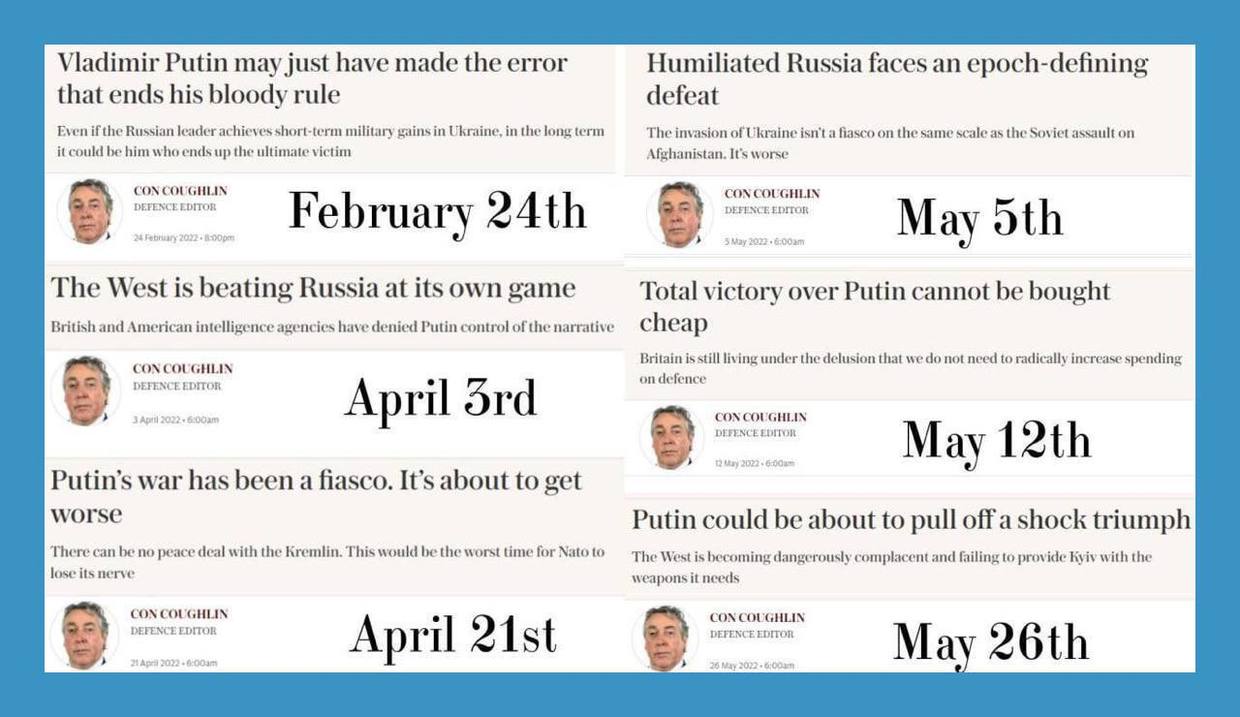
The collective West’s failure to break Russia was apparent even to The Economist, not exactly a publication sympathetic to Moscow. The newspaper reluctantly admitted a month ago that the Russian economy had bounced back from the initial sanctions shock. Meanwhile, it’s the West that has to deal with energy shortages, spiraling costs of living, and record inflation. It’s Americans, not Russians, who can’t find baby formula in stores and can’t afford gas.
Perhaps that’s why this “spring of discontent” with the Western sanctions policy hasn’t been confined to the European side of the Atlantic. On Tuesday, the New York Times ran an op-ed by Christopher Caldwell in which he criticized the Biden administration for “closing off avenues of negotiation and working to intensify the war” by sending more and more weapons to Kiev.
“The United States is trying to maintain the fiction that arming one’s allies is not the same thing as participating in combat,” Caldwell wrote, pointing out that this distinction is getting “more and more artificial” in the information age. A day later, the head of the US Cyber Command admitted to conducting offensive operations against Russia on Ukraine’s behalf.
The US has “given Ukrainians cause to believe they can prevail in a war of escalation,” Caldwell wrote, which is why Kiev isn’t eager to make peace. Indeed, when none other than Henry Kissinger tried to argue in Davos for settling the conflict quickly, Zelensky’s office cursed him out. He was soon designated an enemy of the Ukrainian state.
There had been calls for an off-ramp to be provided even earlier – though few and far between, and lost amid the ongoing cacophony of media cheerleading for Kiev. Back on May 18, the usually hawkish Charles Kupchan of the Council of Foreign Relations advised Ukraine in the pages of The Atlantic to “take the W,” so to speak.
“Russia has already been dealt a decisive strategic defeat,” he wrote. “For NATO and Ukraine alike, strategic prudence argues in favor of pocketing these successes rather than pressing the fight and running the tantamount risks.” NATO, Kupchan added, should advise the Ukrainian government on how to end the bloodshed, and soon.
The very next day, the New York Times’ editorial board echoed his argument, saying a decisive Ukrainian victory over Russia was “not a realistic goal” and that US President Joe Biden should tell Zelensky that there is a limit to which the US will go.
“It is imperative that the Ukrainian government’s decisions be based on a realistic assessment of its means and how much more destruction Ukraine can sustain,” they wrote.
Judging by the official statements coming from both the White House and Kiev, however, the conversation Kupchan and the NYT advised never took place. Instead, the US continues to give Ukraine a blank check.
Speaking of First World War analogies, a senior political scientist at the RAND corporation – a think-tank advising the Pentagon – made one in Foreign Affairs on Tuesday. According to Samuel Charap, the creation of Belgium as a neutral state by its neighbors was to everyone’s benefit for almost a century, with Britain willing to fight Germany in 1914 to preserve it. The neutrality arrangement proposed at the talks in Istanbul in late March could provide Ukraine with the same thing, he said.
Too bad, then, that British Prime Minister Boris Johnson reportedly personally intervened to scuttle those talks back in April, according to Kiev's Ukrayinska Pravda, telling the Ukrainians that if they wanted to make a deal with Moscow, the collective West did not.
Reprinted with permission from RT.
from As Sanctions Fail to Work and Russia's Advance Continues, Western Media Changes its Tune on Ukraine
Thursday, June 2, 2022
Above The Law? What Clinton Lawyer Verdict Says About Politicization Of Justice
The verdict in the Sussman case may seem like just another example of Hillary Clinton "getting away with it." And it is. But there is far more to be concerned about in the case. Also today: Supremes smack down Texas social media law and UK Guardian slams Russia sanctions as counterproductive. Today on the Liberty Report:
from Above The Law? What Clinton Lawyer Verdict Says About Politicization Of Justice
from Above The Law? What Clinton Lawyer Verdict Says About Politicization Of Justice
Subscribe to:
Posts (Atom)