
Wednesday, December 14, 2022

Chaining Down the Tyrant in the Texas Governor’s Mansion

undefined

Texas Governor Greg Abbott went into tyrant mode in 2020 on the excuse of a coronavirus “emergency.” He unilaterally imposed a plethora of mandates and new government programs. Included among Abbott’s actions that year were statewide forced closures of businesses, schools, and other places beginning in March, as well as mandated mask wearing beginning in July.

Abbott’s coronavirus crackdown measures were met with sharp criticism from many Texans. Included among them were some Republican members of the state legislature. Notably, in September of 2020, state Republican Party executive committee members, having had enough of the governor’s power overreach, took the heroic and unusual action in September of 2020 of publicly rebuking Abbott, a fellow Republican, in a resolution approved by a 54 to 4 vote. That resolution called on Abbott “to immediately rescind all COVID-related mandates, closures, and restrictions and to open Texas NOW.” Nonetheless, Abbott continued his coronavirus crackdown.

Abbott has since rescinded much of the unilaterally ordered mandates and programs of his coronavirus crackdown. Abbott even feigned heroism for freedom in March of 2021 when repealing draconian mandates he himself had imposed for many months on people in the state. But, Abbott never apologized for any of these measures or the freedom and prosperity that they trampled; instead he suggests his actions had all been appropriate given the circumstances.

What to do with the unrepentant Abbott who seems just a new crisis of the day away from unilaterally springing on Texans another slew of mandates and programs at the cost of violating their freedom, health, and wealth? To deal with Abbott, as well as any successor in the Texas Governor’s Mansion who may have similar tyrannical proclivities, legal chains must be placed on executive power to protect against that power again being similarly abused.

Last week, Republican Texas state Representative Brian Harrison introduced legislation that promises to restrain Abbott and future Texas governors from unilaterally and tyrannically exercising expansive power during a future “emergency” situation as Abbott did during the coronavirus scare. Whether or not the bill is the perfect solution, it does suggest the sort of steps that must be taken to address the problem. In a Texas Scorecard article last week, Brandon Waltens briefly described key provisions of Harrison’s Liberty Protections in Emergencies Act (HB 911) as follows:
The bill would require emergency orders to be narrowly tailored and subject to expedited judicial review. It would also sunset orders after 30 days if the Legislature does not give their approval, and prevent the governor from reissuing expired or rejected orders.
Waltens also noted in his article an additional fact that suggests chains should be put on Abbott. Waltens wrote that Texas is one of just 11 states still in a “COVID state of emergency” due to Abbott having just last month renewed that order for the state.

Of course, the coronavirus scare revealed tyrants in government across America, not just Abbott in the Texas Governor’s Mansion. It is thus important that every state legislature, local elected body, and the United States Congress consider and, as needed, approve legislation to protect against the next crisis of the day being used by tyrants at any level of government to exercises destructive, expansive, unchecked powers.


from Peace and Prosperity http://www.ronpaulinstitute.org/archives/peace-and-prosperity/2022/december/14/chaining-down-the-tyrant-in-the-texas-governor-s-mansion/

US Patriot Missiles To Ukraine: Game-Changer Or Nuclear War?

Yesterday CNN reported that the Biden administration has decided on a significant escalation in Ukraine: providing Kiev with the most advanced US missile defense system, the Patriot Missile system. The missiles have a longer range and a much higher price tag. Russia has vowed to take them out if deployed in Ukraine. Will NATO troops be operating the complex systems? If so...then what? Watch today's Liberty Report:


from US Patriot Missiles To Ukraine: Game-Changer Or Nuclear War?

Tuesday, December 13, 2022

Was Sam Bankman-Fried Arrested...To Shut Him Up?

The sudden and surprising arrest of FTX mega-scammer Sam Bankman-Fried in the Bahamas has perplexed some of America's top legal minds. Constitutional Law Professor Jonathan Turley is shocked that he was nabbed just before he was set to testify (and further incriminate himself) before the US House Financial Services Committee (Chaired by SBF's old friend Maxine Waters). Politics? Oh, there's also a Ukraine angle. Watch today's Liberty Report:


from Was Sam Bankman-Fried Arrested...To Shut Him Up?

How Will the Blob React if Ukraine Faces Defeat?

undefined

Given Ukraine’s surprisingly effective counteroffensive against Russian forces in the autumn of 2022, there has been an increasing focus among Western officials and their media allies about Russia’s probable response to an overall Ukrainian triumph in the war. There has been far less discussion about how the United States and its European partners will respond if military fortunes change and NATO’s proxy faces definitive defeat. However, such a discussion is essential to avoid making a serious policy blunder.

Western foreign policy experts are split about the Kremlin’s probable response if its military venture in Ukraine implodes. Realists are concerned that Russian President Vladimir Putin might drastically escalate the scope of Russia’s efforts. Such concern is warranted. Indeed, escalation already is taking place, with the partial national mobilization that Putin ordered in September 2022, and the intensified missile strikes on Ukraine’s electrical grid and other infrastructure. Some worried analysts have warned that if Russia faces a definitive defeat in Ukraine, a cornered Putin might even use tactical nuclear weapons to avert a humiliating debacle. Even President Biden has noted the existence of that danger.

More hawkish types, though, insist that Putin is bluffing, and they celebrate Kyiv’s counteroffensive as merely the prelude to a glorious overall triumph. Their implicit assumption is that NATO’s military clout will deter the Kremlin from escalating the stakes. Instead, they apparently believe that the Russian bear will crawl away with its stubby tail between its legs, accepting a diplomatic settlement that returns all occupied Ukrainian territory (including Crimea) to Kyiv’s control. Hawks such as Anne Applebaum have insisted from the outset that a settlement with those characteristics is the only acceptable outcome.

The foreign policy blob’s rosy scenario about the likely consequences of a Russian defeat in Ukraine is worrisome. However, the excessive optimism about Kyiv’s prospective fortunes is equally so. The reality is that while Putin clearly underestimated the tenacity of Ukrainian forces (as well as the extent and effectiveness of NATO’s military aid to Kyiv), Russia still is slowly achieving its territorial objectives while devastating Ukraine’s infrastructure.

One key measure that should be extremely worrisome to Ukraine and its Western patrons is the extent of military casualties. An assessment by Gen. Mark Milley, Chairman of the Joint Chiefs of Staff, in early November 2022 concluded that Russian forces had suffered more than 100,000 dead and wounded since the war began. US news media outlets highlighted that number in headlines about Milley’s report. What received far less attention was his admission that Ukrainian forces also had suffered more than 100,000 casualties. That point was significant because Russia’s military is much larger than Ukraine’s, and Russia’s overall population is more than 3 times larger than Ukraine’s. In other words, Russia can absorb such gruesome losses easier and longer than Ukraine can. As the war drags on and turns into a human meat grinder, Ukraine’s fortunes fade, not brighten.

The Biden administration may be cynical about such consequences, since the template for Washington’s use of Ukraine as a military proxy against Moscow was using the Afghan mujahidin in the 1980s to bleed the Soviet Union’s occupation forces. That policy ultimately succeeded, albeit at great cost in multiple respects to the Afghan people. However, as I have pointed out elsewhere, Ukraine is a much more vital interest to Moscow than Afghanistan ever was. Hence, the Kremlin’s willingness to accept a humiliating withdrawal from Ukraine is extremely unlikely.

Moreover, although administration officials may be cynically pragmatic about using Ukraine as a proxy only as long as the strategy proves effective, Kyiv has legions of genuine admirers in the foreign policy blob and the news media. The pervasive, bogus portrayal of Ukrainian President Volodymyr Zelensky as a noble figure akin to Winston Churchill, and Ukraine as plucky liberal democracy resisting an invasion by a vicious aggressor, makes it difficult for Washington to abandon its proxy – even if Kyiv’s fortunes turn bleak. Having argued that Ukraine is on the front lines of a global, existential fight between democracy and autocracy, which the administration and its allies in the blob have done repeatedly, it will be difficult to retreat from that stance.

A very real risk exists that if Russia’s impending winter offensive – or some later offensive – routs Ukrainian forces, there will be tremendous pressure on the Biden administration to intensify rather than reduce US support for Kyiv. Indeed, there would almost certainly be calls for direct NATO military involvement in the war. Escalation could take the form of imposing a no-fly zone over Ukraine or even deploying US combat forces in that country.

The risks associated with such dramatic moves should be obvious and horrifying, but those influential figures who have embraced the war as a holy crusade against Russian aggression and the alleged global menace of autocracy may not be deterred by such considerations. Members of the US foreign policy establishment do not have a good track record about being willing to abandon failed enterprises. They persisted in the Vietnam War for years after it was apparent that Washington’s clients in Saigon could not win. More recently, they stubbornly refused to recognize the bankruptcy of US policy in Afghanistan for nearly two decades.

It is hard to imagine that people with the same mentality will abandon Ukraine after exerting every effort to portray that country as a vibrant democracy and a crucial ally. Indeed, the tsunami of hostility from such quarters to the tepid call (quickly retracted) from the House Progressive Caucus for a greater emphasis on diplomacy to end the war indicates the extent of fanatical support for Ukraine. Calls for escalating Washington’s commitment are likely to be embraced by the blob, despite the excessive risks to the American people. Americans who want to prevent their country from becoming even more entangled in the Ukraine conflict must be prepared to rebuff such efforts.

Reprinted with permission from Antiwar.com.

from How Will the Blob React if Ukraine Faces Defeat?

Oklahoma, Texas, and Other Schools Join UChicago Alliance on Free Speech

undefined

I have previously written of my pride as an alumnus of The University of Chicago in how the school has led the fight for free speech in higher education. It is also ranked as the number one free speech school in the country. The “Chicago statement” has become the rallying point for schools resisting the anti-free speech movement sweeping over our university and college campuses. Now both the University of Oklahoma and entire University of Texas system have joined almost 100 schools in signing on to the statement. It remains a minority of schools but the ranks are growing (though often due more to boards than votes of the faculty). Unfortunately, George Washington University (which has been ranked low on free speech rights) has not agreed to this basic statement of free speech protection.

UChicago shocked many in 2016 when it sent a letter to incoming students that promised an unfettered and uncensored education without the protection from disturbing or offensive ideas. While most schools are actively curtailing free speech, its letter warned the students that they will not be protected against ideas or given “safe spaces.”

The origins of the letter is found in a policy produced at the University of Chicago in 2014-2015. The Chicago Statement’s key provision declares that a university’s...
...fundamental commitment is to the principle that debate or deliberation may not be suppressed because the ideas put forth are thought by some or even by most members of the University community to be offensive, unwise, immoral, or wrong-headed. It is for the individual members of the University community, not for the University as an institution, to make those judgments for themselves, and to act on those judgments not by seeking to suppress speech, but by openly and vigorously contesting the ideas that they oppose. Indeed, fostering the ability of members of the University community to engage in such debate and deliberation in an effective and responsible manner is an essential part of the University’s educational mission.
The Chicago Statement also states unequivocally that students cannot “obstruct or otherwise interfere with the freedom of others to express views.” That latter statement stands in contrast with many academics who believe that stopping others from speaking is free speech.

Both students and some faculty have maintained the position that they have a right to silence those with whom they disagree and even student newspapers have declared opposing speech to be outside of the protections of free speech. At another University of California campus, professors actually rallied around a professor who physically assaulted pro-life advocates and tore down their display.

In the meantime, academics and deans have said that there is no free speech protection for offensive or “disingenuous” speech. CUNY Law Dean Mary Lu Bilek showed how far this trend has gone. When conservative law professor Josh Blackman was stopped from speaking about “the importance of free speech,” Bilek insisted that disrupting the speech on free speech was free speech.

I do not understand why many academics have supported or stayed silent as our faculties have become intellectual echo chambers. However, it is depriving our students of the type of diverse and vibrant intellectual environment that many of us enjoyed as undergraduates.

When I attended the University of Chicago in the 1980s, I found myself in the midst of an intellectually vibrant community with a cacophony of voices, from Trotskyites to black nationalists to radical feminists to creationists. Then-President Hanna Gray told us that “education should not be intended to make people comfortable; it is meant to make them think.” And it did. Students thought a lot about where they fit in this world of ideas.

The University of Oklahoma Board of Regents voted to adopt the “Chicago Statement” last week.

That followed the adoption by the entire University of Texas system. The board announced that the board “guarantees all members of the UT System the broadest possible latitude to speak, write, listen, challenge, and learn.” It also declared that “debate or deliberation may not be suppressed because the ideas put forth are thought by some or even by most individual members of the UT System community to be offensive, unwise, immoral, or wrong-headed.”

UChicago has forced schools and faculty to take sides in this existential fight over free speech. While faculty members rationalize reasons not to support the statement, there is increasingly a sharp and clear divide among schools. The Chicago statement has become the battle line for not just free speech but the future of higher education. While many choose to ignore the rising orthodoxy on our campuses and lack of intellectual diversity on our faculties, this trend will ultimately destroy the essential element of free inquiry and expression needed for higher education.

Reprinted with permission from JonathanTurley.org.

from Oklahoma, Texas, and Other Schools Join UChicago Alliance on Free Speech

What Is CISA and Why Does It Matter?

undefined

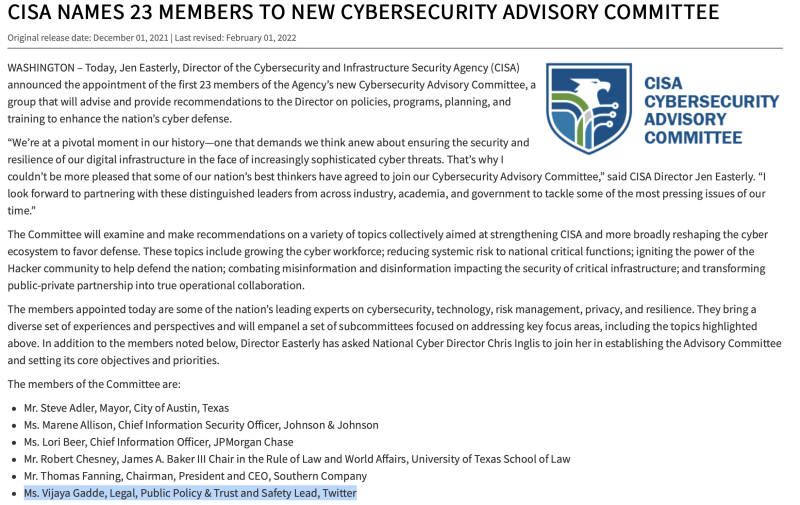
On October 27, 2022, Elon Musk fired Vijaya Gadde from her job at Twitter where she was general counsel and the head of legal, policy, and trust. It became quickly obvious to him and others on his team that it was she who drove the censorship policy within the company, including that which blocked all information about Hunter Biden’s laptop before the 2020 election and otherwise shut down critics of government Covid policy. 

Her termination from Twitter did not leave her unemployed and homeless. A year earlier, she had already been tapped as an advisor to CISA, which is the government’s Cybersecurity and Infrastructure Security Agency headed by Jen Easterly, who was chosen to head the new agency (created in 2018) out of her tenure at the National Security Agency. As Freddy Gray puts it in the UK Spectator, “That seems fishy, to put it mildly.”

undefined
(Bigger)

Easterly was called to give a deposition in the case brought by the Attorneys General of Missouri and Louisiana but the government rejected the idea. Fauci and others could be called but not the head of CISA. According to Epoch Times, the judge “ruled that three of the individuals—Murthy, Easterly, and Flaherty—will no longer be required to appear for a deposition after a federal appeals court blocked the move last month, stating that the judge had failed to consider whether alternative and less ‘intrusive’ means could be used to obtain the information being sought.”

Don’t want to be intrusive, right? That would be inhumane. Can’t make such a demand of the head of CISA.

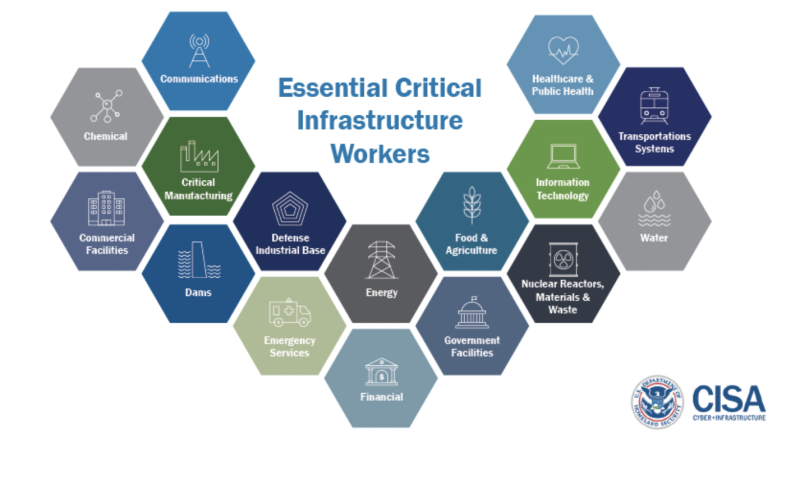
And yet, it was CISA itself that gave the whole of the initial advisory in 2020 for all the stay-at-home orders that were imposed around the country. The agency is also the one primarily responsible for the division of the whole of the American workforce into sharp lines between essential and nonessential. It was a clear sign that something had gone very wrong, even to the point of feeling like martial law. 

I’ve puzzled about where this all came from for almost three years. Thanks to research done by many Brownstone writers, we now know. It was CISA from the very beginning. Indeed the webpage laying it all out still survives, including a video. You can look at it all here. 

The initial edict was issued March 19, 2020, three days following the catastrophic press conference that announced the need for universal social distancing and issued what is surely one of the most totalitarian edicts in the history of public policy: “indoor and outdoor venues where groups of people congregate should be closed.” 

CISA explained the exception. It includes this helpful graphic of those who were entitled or even required to work while everyone else stays home. 

undefined
(Bigger)

Note the inclusion of communications, which of course, means all media, and of course information technology, which means all Big Tech. As for “commercial facilities” that ended up meaning big-box chain stores while small businesses were brutally shut. Reinforcing the Trump administration’s fatwa against “bars, restaurants, and gyms,” they were closed immediately following the release of CISA’s order. 

But of course, and consistent with all this machinery, CISA was careful to note that “This guidance was provided to clarify the potential scope of critical infrastructure to help inform decisions by state and local jurisdictions, but does not compel any prescriptive action.” 

Further: “This guidance is not binding and is primarily a decision support construct to assist state and local officials. It should not be confused as official executive action by the United States Government.”

This way, like Fauci, CISA can claim that it didn’t force the shutdown of anything. It only made recommendations and state-level agencies took it from there. And yet here is a FAQ to give you a sense of the military footing that the whole country entered up on in the course of only a few days. 
How is this different than traditional disasters or emergencies impacting critical infrastructure?

COVID-19 is different than any emergency the Nation has faced, especially considering the modern, tightly interconnected economy and American way of life. In traditional emergencies, government coordinates with the private sector to get businesses back to business. In this case, as the government works with partners to slow the spread of COVID-19, the economic goal is maintaining resilience of the Nation’s foundation—its critical infrastructure.
In retrospect, the whole thing seems truly hard to believe, all for a respiratory virus with an infection fatality rate that compares with the flu except with a huge risk gradient by age. A military-style cooperation was unleashed on the entire country even as basic therapeutics were completely neglected and concern for collateral damage to health, culture, education, and enterprise were tossed out the window. 

The initial lockdowns were followed by quarantine rules, travel restrictions, violations of religious freedom, forced masking and eventually forced medicalization of quickly approved shots that most of the population never needed and vast numbers now regret. 

As CISA said, this crisis was “different than any emergency the Nation has faced.” Instead of keeping business going, the response this time was massive destruction of everything except “critical infrastructure.”

Indeed, the whole country fell into complete shambles and trauma for the better part of 2020, leading up to the November elections that gutted Republican control of Congress and flipped the White House. We are now finding out with piles of evidence that this was the ambition of many employees at Twitter, including the general counsel who ended up as a consultant to the very agency that issued the stay-home advisory. 

CISA is part of the Department of Homeland Security, created only in 2018 with an act signed by President Trump. As is clear from the text of the law, the whole point was to protect the nation against cyber attacks and develop a response. Nowhere in the text could one discern a broad edict to divide the whole workforce, crush civil liberties, smash businesses, and trample on the Bill of Rights, much less shepherd into being a vast machinery of censorship that would effectively nationalize all major tech platforms on behalf of regime priorities. 

On the weekend of March 14-15, 2020, Trump surrounded himself with a handful of advisors including Fauci, Birx, Pence, Kushner, along with a few outside consultants from pharma and tech, and agreed to “15 days to flatten the curve.” It seems highly unlikely he knew that he was approving a complete takeover of the country by the national security arm of the government, much less empowering this one agency with the task of crushing the whole economy except that which government called essential. 

We are finding out ever more about what went on behind the scenes, especially thanks to the exceptional research of Debbie Lerman, who has fleshed out the underlying shift that occurred in these days. We went from being a normal nation with all the usual struggles to a country under quasi-martial law, ruled by administrative bureaucrats drawn from the national security arm of government. CISA was an agency that led the charge. Did Trump have any idea what he had approved? I would say it is highly doubtful. 

I’ve been unable to find out anything about the agency’s budget or payroll but we do know that it is hiring: “CISA is always searching for diverse, talented, and highly motivated professionals to continue its mission of securing the nation’s critical infrastructure. CISA is more than a great place to work; our workforce tackles the risks and threats that matter most to the nation, our families, and communities. With more than 50 career fields available CISA offers multiple opportunities as well as multiple tracks for employment.”

A perfect home for many thousands of fired Twitter employees, no doubt.

Reprinted with permission from Brownstone Institute.


from What Is CISA and Why Does It Matter?

Monday, December 12, 2022

Did The Pentagon Really 'Green Light' Ukraine Strikes Inside Russia?

The London Times newspaper reported on Friday that the US has given Ukraine the "green light" to fire missiles deep into Russian territory, reportedly based on lack of Russian response to previous provocations. Are the neocons-in-charge determined to destroy the world? Also today: US sends 'biggest arms dealer' back to Russia? And: Why the new military budget is a massive waste of money. Watch today's Liberty Report:


from Did The Pentagon Really 'Green Light' Ukraine Strikes Inside Russia?