Is the Russian incursion into Ukraine a desperate "land grab" by an unhinged Russian president? Is it as simple as that? That is what the mainstream media across the political spectrum is pumping out. And, as with all propaganda wars, anyone outside the lines is demonized. But what if there is something beyond the bumper sticker talking points? Watch today's Liberty Report:
from What's To Blame For The Mess In Ukraine?
Monday, February 28, 2022
It All Comes Back to NATO

When the Bush Administration announced in 2008 that Ukraine and Georgia would be eligible for NATO membership, I knew it was a terrible idea. Nearly two decades after the end of both the Warsaw Pact and the Cold War, expanding NATO made no sense. NATO itself made no sense.
Explaining my “no” vote on a bill to endorse the expansion, I said at the time:
NATO is an organization whose purpose ended with the end of its Warsaw Pact adversary… This current round of NATO expansion is a political reward to governments in Georgia and Ukraine that came to power as a result of US-supported revolutions, the so-called Orange Revolution and Rose Revolution.Unfortunately, as we have seen this past week, my fears have come true. One does not need to approve of Russia’s military actions to analyze its stated motivation: NATO membership for Ukraine was a red line it was not willing to see crossed. As we find ourselves at risk of a terrible escalation, we should remind ourselves that it didn’t have to happen this way. There was no advantage to the United States to expand and threaten to expand NATO to Russia’s doorstep. There is no way to argue that we are any safer for it.
Providing US military guarantees to Ukraine and Georgia can only further strain our military. This NATO expansion may well involve the US military in conflicts unrelated to our national interest…
NATO itself was a huge mistake.
When in 1949 the US Senate initially voted on the NATO treaty, Sen. Robert Taft – known as “Mr. Republican” – gave an excellent speech on why he voted against creating NATO.
Explaining his “no” vote, Taft said:
… the treaty is a part of a much larger program by which we arm all these nations against Russia… A joint military program has already been made… It thus becomes an offensive and defensive military alliance against Russia. I believe our foreign policy should be aimed primarily at security and peace, and I believe such an alliance is more likely to produce war than peace.Taft continued:
If we undertake to arm all the nations around Russia…and Russia sees itself ringed about gradually by so-called defensive arms from Norway and Denmark to Turkey and Greece, it may form a different opinion. It may decide that the arming of western Europe, regardless of its present purpose, looks to an attack upon Russia. Its view may be unreasonable, and I think it is. But from the Russian standpoint it may not seem unreasonable. They may well decide that if war is the certain result, that war might better occur now rather than after the arming of Europe is completed…How right he was.
NATO went off the rails long before 2008, however. The North Atlantic Treaty was signed on April 4, 1949 and by the start of the Korean War just over a year later, NATO was very much involved in the military operation of the war in Asia, not Europe!
NATO's purpose was stated to "guarantee the safety and freedom of its members by political and military means." It is a job not well done!
I believe as strongly today as I did back in my 2008 House Floor speech that, “NATO should be disbanded, not expanded.” In the meantime, expansion should be off the table. The risks do not outweigh the benefits!
from It All Comes Back to NATO

Saturday, February 26, 2022
Ukraine: The Propaganda Wars

(This is a version of an RPI update to subscribers sent yesterday. Subscribe here.)
The media and the war machine (or do I repeat myself?) want us to take sides in the Russo/Ukraine war. To those of us with long histories in military conflicts in which the US foreign policy establishment, media, and military have an interest, the terms are always framed as white hats and black hats - and you had better choose a side!
"Are you on the side of FREEDOM or are you a puppet of [insert Hitler proxy here]?"
You must take a side. (In fact you must choose the side the Beltway blob wants you to choose).
The US government never fights in the self-interest of the elites. It only fights (directly and by proxy) for the freedom and liberation of others. If you doubt that you are un-American. History started when they tell you it started. Never mind about the past or how US intervention created the circumstances that led to whatever horrible outcome we witness.
The Iraqis would greet us as liberators, we were told. They will love our bombs. Likewise the Libyans once their leader is knife-raped to death. And then of course the Syrians once our al-Qaeda "moderate" head-choppers are put in charge. The rest of the world is so so grateful that the omniscient Washington foreign policy elites can choose their fate for them. Surely they are too foolish to decide for themselves!
Ironically, as the US government and its obedient media were hysterically telling us we must demand Russian blood for their attack on a Ukraine that had not attacked them first, the US government that same day bombed a Somalia that had not attacked it first. And let's not even talk about the horrific Saudi genocide (with full US support) in Yemen.
With one voice the US media, political elites, and brainwashed sheeple scream out: "You can't just go and attack a country that hasn't attacked you!!!" And the people of Iraq, Syria, Libya, Somalia, Yemen, and yes even Afghanistan scratch their heads in wonder at the ignorance, hypocrisy, and cynicism.
Like an alcoholic may occasionally get a moment of clarity, a politician may sometimes get a moment of honesty. California US Congressman and lead "Russiagate" conspiracy theorist Adam Schiff, spilled the beans in a 2020 speech:
The US uses Ukraine to fight Russia, but then when Russia fights back we have to pour all our vodka into the street and launch WWIII.US chauvinism & warmongering is so ingrained that @AdamSchiff can openly declare, in Jan 2020, that US uses Ukraine to “fight Russia over there,” and our elites applaud. Fast forward two years later when Russia fights back, and the same circle is outraged. pic.twitter.com/6B4QVFSZvV
— Aaron Maté (@aaronjmate) February 26, 2022
The US military-industrial-media-Congressional complex that is behind this disastrous policy knows well, however, that war brings bigger dividends:
This is not a WHATABOUT column, however. It's just to point out how manipulated Americans are by the unholy partnership between government, Washington parasitical elites, and the media.Biden’s anti-war coalition of Raytheon, Lockheed Martin and Northrop Grumman sends $350 million in love weapons for NATO’s nonviolent war against Russia and the Azov battalion’s pacifist-style shelling of the Donbas. https://t.co/sYntONlss2
— Dan Cohen (@dancohen3000) February 26, 2022
Perhaps the only thing worse are the third-tier flunkies who do their bidding in international organizations.
Yesterday NATO Secretary General Jens Stoltenberg announced that NATO countries were going to send more weapons to Ukraine. Brilliant! Bureaucrats, especially stupid ones, always double down then their policies are shown to be failures.
As one report quoted the failed Swedish politico/NATO chief:
'We see rhetoric, the messages, which is strongly indicating that the aim is to remove the democratically-elected government in Kiev,' he announced after a meeting with NATO leaders.What? NATO must send weapons to Ukraine because Russia is attempting to remove its democratically-elected government? How dare they! Don't they know that's OUR job?
Here's the side we should be on in Ukraine and everywhere else: non-intervention in the affairs of others. Today's Ukraine nightmare is the product of a US foreign policy that overthrew not one, but two elected Ukrainian governments because the people chose a president that Washington's pampered elites didn't like.
As I wrote in an article yesterday, one thing we can take with us from Russia actually doing what it long said it would do if Ukraine was armed by hostile governments and pulled toward NATO membership is that:
Whether America and the EU like it or not, the era of 'We're an empire now, and when we act, we create our own reality' is well and truly over. Its end is not to be mourned but to be celebrated. The only pro-America foreign policy is non-intervention in the affairs of others.Yes, this is a good thing and it should be celebrated. Don't worry - it's not un-patriotic to applaud an authentically pro-America foreign policy! Now is the time to demand a change in how things are done. It does not weaken the US to decide to not meddle in the affairs of others. On the contrary, we are strengthened by shrugging off the burden of (very badly) running the rest of the globe.
Unless anyone believes we are stronger by burning one trillion dollars for the US military empire each and every year.
Let's ask the truckers and the waiters and the welders of America how they like billions of their hard-earned dollars laundered to the ultra-rich Beltway elites through corrupt regimes abroad. Foreign aid is falsely perceived as a plate of rice and beans to a motherless child in a war-torn hellhole. The reality is that foreign aid is that which re-models all the bathrooms in million dollars mansions in McLean VA and its evil environs.
Gold plated Beltway toilets. The ignoble flotsam of the corrupt US empire.
from Ukraine: The Propaganda Wars
Friday, February 25, 2022
The Israeli data that nukes the Pfizer vaccine: What did Pfizer know and when did they know it?

Last year, Philip Dormitzer, the chief scientific officer at Pfizer, described Israel as “a sort of laboratory” to “see the effect” of his company’s vaccines. Well, it took over a year into the vaccine drive that injected most Israelis with three shots and some with four to finally publish information on adverse events. What Israel published earlier this month based on a health ministry survey of 2,049 people who got booster shots is not only damning, but unmistakably revealing that there is no way Pfizer did not see these adverse events during the clinical trials in 2020. What did they know and when did they know it?
On Feb. 10, the Israeli Health Ministry published (English version here) the results of a survey of adverse events among roughly 2,000 random Israelis who received booster shots. It’s shocking that it took this long for them to conduct such a survey and didn’t do this a year ago, but it’s better late than never. Just the top-line numbers from the survey should alarm us all. A total of 75% of women and 58% of men reported experiencing at least one side effect within the 21- to 30-day follow-up period of the interview. Obviously, the majority of these were minor, but 51% of the women and 35% of the men who experienced a side effect reported that as a result, they had difficulty performing daily activities.
Full stop right there. Even before we get into more serious problems. Just the fact that the shot knocked out such a massive percentage of people clearly violates the informed consent through which the shots were marketed and most certainly makes any mandate immoral. Right off the bat, it’s clear that this is not like taking a vitamin D pill. Moreover, the fact that we have zero long-term studies, but such a massive percentage get at least a sick feeling from it in the short run should concern everyone. Again, why wasn’t such a survey done in January 2021 after the first dose?
Just take a look at the massive percentage of reports, especially for females, experiencing weakness, muscle ache, shaking, high temperature, and even dizziness and vomiting.

(bigger)
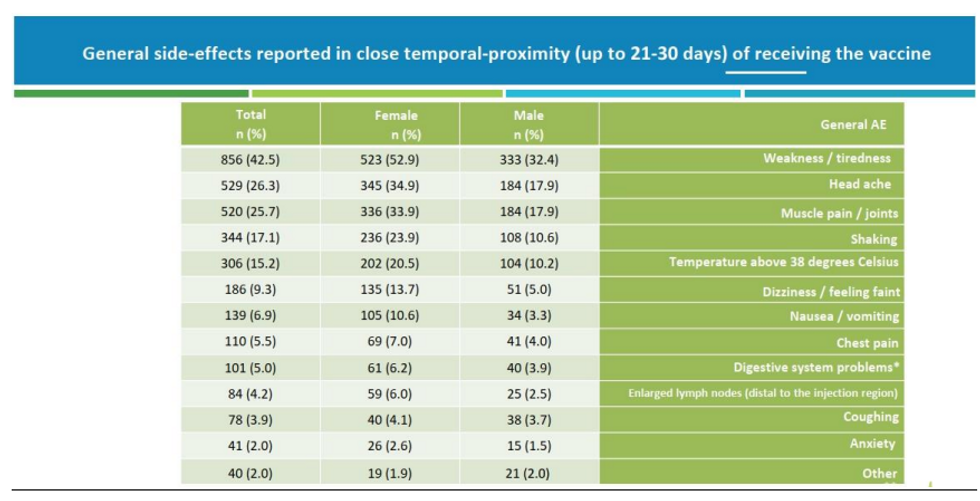
That is a massive percentage for a product ubiquitously marketed, endorsed, distributed, and then mandated by global governments as the safest and most effective vaccine of all time. And all for a virus that, with most younger people, would cause roughly the same symptoms anyway even after being vaccinated. The fact that this shot was even marketed to younger and healthier people is insane. Yes, some people might have willingly taken a shot if they thought they’d get some flu-like symptoms, but that confidence – that the flu-like symptoms don’t portend more severe long-term damage – can only work for an established vaccine that already has long-term safety data.
Now, let’s get to some of the more serious or potentially serious issues. The same table shows that 5.5% reported experiencing chest pain. We already know that there are major safety concerns for cardiovascular issues and that the spike protein is very pro-inflammatory and potentially thrombotic. And remember, this is 5.5% of just one dose. If you extrapolate that to America, where 551 million doses have been administered, that would be approximately 30 million cases of chest pain! It doesn’t necessarily mean that it causes short-term or long-term damage, but again, with a new vaccine with a novel and dangerous mechanism of action and no long-term safety studies, how can this be allowed to continue without further study?
A total of 4.5% of those who received booster doses reported neurological side effects. Assuming the doses are all relatively the same, that would extrapolate to roughly 25 million cases of neurological side effects in the United States. It would lend a lot of credence to the military whistleblowers who report seeing more than a tenfold increase in nervous system diagnoses in 2021 and leaves no doubt that the DOD was bluffing when it responded with “revised” data showing not even a modest increase.
There’s no doubt that the spike protein of the pathogen causes nervous system disorders in some people, just like it causes cardiovascular disorders, but clearly the shots do as well, and remember they don’t prevent you from getting the pathogen.
Read the rest here.
from The Israeli data that nukes the Pfizer vaccine: What did Pfizer know and when did they know it?
Thursday, February 24, 2022
Fog Of War: What's Behind Russia's Ukraine Strike?
Russia's wide-ranging assault on Ukrainian military targets in the early hours of the morning has surprised Western capitals even as they repeatedly predicted an imminent attack. Propaganda machines on all sides are turned up to maximum. In today's Liberty Report we try to break down the facts and the antecedents with an eye on where things might go from here. Watch today's program:
from Fog Of War: What's Behind Russia's Ukraine Strike?
from Fog Of War: What's Behind Russia's Ukraine Strike?
Wednesday, February 23, 2022
Why a war may be the only solution Americans can bring to this conflict

The US used to produce experts on Soviet and Russian affairs like Jack Matlock. Today we get the likes of Michael McFaul. The decline of popular interest in Russian-area studies, combined with intellectual laziness on the part of the average US citizen, is to blame.
On February 21, Russia’s President Vladmir Putin gave what will most likely go down in history as one of the most important speeches in modern history. It was a brutally honest example of how current events are shaped by the forces of history. What is important about this speech isn’t so much the content–that is now part of the historical record–but rather how it was absorbed and interpreted by those who watched it.
As an American imbued with more than a little first-hand insight into Russian affairs, I have been struck by the inability of the American people to comprehend the historical foundation of Putin’s speech. It is not my place to either attack or defend the details put forward by the Russian president. I would hope, however, that my fellow citizens would be able to engage in an informed, intelligent, and rational discussion about the speech, given the immense geopolitical ramifications attached to it.
Unfortunately, the average American, lacking both the intellectual training and the critical resource of time, is ill-equipped to participate in such an exercise. Instead, they have subordinated this task to a category of public servant known as the “Russian expert.” Under normal circumstances, one might find the existence of such a class a relief; after all, Americans are willing to entrust their financial security to “financial managers.” Why not surrender the intellectual machinations required to make sense of something as complex as Russian affairs and all that topic entails to the hands of the specialists, men and women schooled in the history, economy, culture, and language of Russia?
This isn’t the first time Americans have been called upon to entrust critical Russia-related analysis and the decision-making derived therefrom to so-called “experts.” From 1945 through 1991 the US and Soviet Union were engaged in a massive geopolitical conflict known as the Cold War. I happened to be an eyewitness to the final years leading up to the collapse of the Soviet Union, and to a speech which, in its own way, was as impactful as the one given by Vladimir Putin this week.
On June 28, 1988, I was in the second week of work as a member of the advanced party of US inspectors dispatched to the Soviet city of Votkinsk, located about 700 miles (just over 1,000km) east of Moscow, in the foothills of the Ural Mountains. Our job was to work with our Soviet colleagues to make the necessary preparations to receive the main body of 25 inspectors scheduled to arrive on July 1, 1988, when portal monitoring operations began, a month after the Intermediate Nuclear Forces (INF) treaty entered into force. On that date, we would begin our treaty-mandated task of monitoring the activities of the Votkinsk Missile Final Assembly Plant, located some 12 kilometers outside the city of Votkinsk, to make sure the Soviets no longer produced ballistic missiles that had been banned under the terms of the treaty.
The advance party was billeted in a well-kept Dacha situated in the woods on the outskirts of the city. Built to house the former Minister of Defense Dmitry Ustinov and his entourage during their frequent visits to Votkinsk, the Dacha was equipped with a well-stocked kitchen, a pool table, and a lounge where one could watch Soviet television. On the evening of June 28, I was surprised to find my Soviet hosts gathered around the television screen. That evening, Mikhail Gorbachev, the General Secretary of the Communist Party of the Soviet Union (CPSU), had convened the 19th All-Union Conference of the CPSU. At first blush, I gave the event no thought–just another communist party “yes” fest with officials falling over each other in fawning admiration of a totalitarian leader. I said as much to one of my hosts, an official from the Ministry of Foreign Affairs.
“You couldn’t be further from the truth,” he replied. “This is a revolution!”
Over the course of the next three days, during breaks from what was a very busy schedule, I joined my Soviet hosts as we watched history unfold before us. Gorbachev was introducing real reform–perestroika–to the Soviet people. He was being challenged by the communist party, in the form of his deputy, Yegor Ligachev, and by reformers, in the person of Boris Yeltsin. The conference had turned into an ideological battleground, where the future of the Soviet Union was being decided live, in public, before the Soviet people, for the first time in its history.
If you had asked the average American citizen about the importance of the 19th All-Union Party Conference at the time it transpired, they wouldn’t have been able to provide an intelligent answer. Even though the Soviet Union had been elevated to the status of an “Evil Empire” with which the US was prepared to engage in all-out nuclear war to constrain, the American public at that time, much like their counterparts today, was satisfied to leave the heavy thinking in the hands of a class of civil servant, the ‘Soviet expert’ who would monitor the situation and advise the political leadership, and, as needed, the public.
Among those who constituted this ‘Soviet expert’ class were a category of military officers known as ‘Soviet Foreign Affairs Officers,’ or FAOs. Provided with advanced linguistic training and graduate-level education before attending a year-long finishing school, the US Army Russia Institute, located in Garmisch, West Germany, a Soviet FAO was a subject-matter expert whose mission was to provide critical insight to policy makers about Soviet issues and, as needed, carry out specific military tasks–such as implementing the INF treaty.
The disparity between the Soviet FAO and his or her civilian counterpart was played out live in Votkinsk. The advance party consisted of five persons–three military officers (two FAO-qualified and me) and two civilian civil engineers. At night, when the work was done and the television turned on, you would find the two civil engineers playing pool or reading a book, while the three military officers were glued to the television set.
Over the course of the next two years, I bore witness to two critical events transpiring in parallel–the implementation of the INF treaty, and the implementation of perestroika. Both played an important role in shaping the events that led to the eventual collapse of the Soviet Union. As trained Soviet experts, the FAOs and I were able to provide invaluable insight into the phenomenon of perestroika in the hinterlands of the Soviet Union. That which empowered us was the education we had received in Russian history and affairs from an American academic establishment that had, since the end of the Second World War, been prepared for just this task.
The Soviet FAO, together with their counterparts in the State Department and US Intelligence Community, were the beneficiaries of an education system which had seen an explosion in Russian Area Studies during the Second World War, when the Soviet Union was considered an ally, and which only grew after the war ended, and the Soviet Union was reclassified as an enemy. The unique circumstances which gave rise to the study of Russian Affairs in the US allowed for the retention of academic integrity in the face of ideological pressure to paint the Soviet Union in a negative light.
One of the clearest examples of this phenomenon can be found in the person of Richard Pipes, a renowned American academic who specialized in Soviet and Russian history and who taught at Harvard for decades while advising various US presidents, most notably Ronald Reagan, on matters pertaining to Soviet policy. Pipes was decidedly anti-Soviet, and the advice he provided was decidedly hardline in nature. His writings, however, were derived from historical fact subjected to proper analysis and scrutiny. His book, The formation of the Soviet Union: Communism and nationalism, 1917-1923, was mandatory reading for any student of Russian studies (indeed, it should be mandatory reading today, given the correlation between its subject matter and the content of Putin’s February 21 speech.) I have a first-edition copy of Pipe’s book in my personal library, and I have made extensive use of it over the years as I try to discern what is transpiring inside the former Soviet Union, and why.
Every one of my Soviet ‘expert’ counterparts was a byproduct of an American system of education designed to empower those who participated with critical fact-based discernment skills, capable of separating fact from fiction and filtering out personal and institutional bias. The result was a system that produced people like Jack Matlock, the US Ambassador to the Soviet Union during its final years, and George Kolt, the CIA’s top Soviet analyst. Both will go down in history as predicting the collapse of the Soviet Union (the thing about experts is that while their advice might be prescient, it is still held hostage by politicians who answer to a domestic constituency which is often unmoved by fact-based analysis.)
The end of the Cold War, however, brought with it the end of both the Soviet expert and the academic establishment that produced them. By way of example, I had been given two classified commendations by the Director, CIA, for my work in the Soviet Union. But in 1992, after being invited to CIA Headquarters to interview for an analytical position, I was told by the head of the new Russia analytical unit that I was too imbued with “Cold War” thinking; the world had moved on.
Russia became a playground for a new category of ‘expert,’ the political and economic ‘exploiter’ who viewed Russia as a defeated power subject to the whim of the American victor. This class was dominated by the likes of Michael McFaul and his ilk, people who viewed Boris Yeltsin not as the by-product of Soviet and Russian history, but rather a malleable tool in their effort to transform Russia into a compliant “democracy” subservient to their new American masters.
Russian-area studies stopped being the go-to major when it came to interacting with the former Soviet Union, replaced by business and economics degrees sought by people whose purpose wasn’t to understand Russia but rather to exploit it. Interest in Russian studies dwindled, a byproduct of a decline in interest and numbers, in terms of graduate students and faculty. Moreover, the system became infected by the reality of “garbage in, garbage out”: as the old Cold War Soviet specialists were retired from their posts in academia, they were not replaced by people possessing similar academic discipline, but rather a new generation of academics governed more by political perception than fact-based reality. Again, Michael McFaul comes to mind, a man driven not by the complex history of the Soviet Union and Russia, but rather his own vision of what Russia should be.
It is the Michael McFauls of the world who dominate the mainstream media today, people whose academic pronouncements are in keeping with government-approved dogma and, as such, sympathetic to the media corporate executives who work hand-in-glove with the government to spoon-feed what passes for “objective truth” to the American people. Jack Matlock still writes on Russian affairs, his articles providing a fresh, fact-based look at the reality of what is transpiring in Russia today. A public debate between he and McFaul would be most welcome by those who truly seek insight into what is happening in Russia (I consider myself a student of Ambassador Matlock, and if he is not able to throw down the gauntlet of debate, I am–consider the challenge made, Mr. Ambassador!)
The American people are being poorly served by the new class of Russian experts to whom they have relegated all intellectual examination of current Russian affairs. Maybe when gasoline prices skyrocket, and inflation further shrinks their already burdened paycheck, the average American citizen might sit up and take notice. By then, however, it will be too late.
Vladimir Putin’s speech of February 21, just like Mikhail Gorbachev’s address at the 19th All-Union Party Conference in June 1988, should be viewed and assessed with expert eyes, trained to discern fact-based intent and relevance. This happened back in 1988, and we were able to effectively manage the collapse of the Soviet Union. It is not happening today, and we may very well find ourselves neck deep in a conflict which we do not understand and for which we have no answer other than war.
Reprinted with permission from RT.
from Why a war may be the only solution Americans can bring to this conflict
The New ‘Russiagaters’: Right-Wingers Channel Hillary in Attacks on Biden

"Bad" Vlad Putin only "took over" part of Ukraine because of President Biden's weakness. So says many in the US right wing. A "real man" president would have imposed costs so prohibitive that Putin would never have dreamed of recognizing what has been de facto reality since 2014: that the Russian-speaking part of Ukraine wants no part of the US-installed government in Kiev.
So goes the thinking of the armchair right-wingers. And I don't even mean neocons: plenty of those now scoring body blows on our president-on-the-ropes are Trumpers and even populists. The question to these "weak Biden" jaw-boners remains: what would you have done to show how "tough" you are that would sufficiently terrify the Russian president into accepting US missiles on (what would be) NATO-member Ukraine's soil? Nuke Moscow out of the blue? And sacrifice the United States in the process?
That's "pro-America"? Killing America?
These are not serious people. In fact they are carbon copies of their supposed nemeses like Rachel Maddow and Adam Schiff.
Former (Trump) White House Press Secretary Kayleigh McEnany, who I am sure is pleasant enough, has dusted off her camos and is declaring war on Biden for "showing weakness" that invited Putin to rampage through Europe reconstituting the Third Reich...or something like that:
"There is no greater supporter of the Democrat Party than Vladimir Putin!”
— Kayleigh McEnany (@kayleighmcenany) February 22, 2022
“He got Crimea on Obama's watch, and now he's getting exactly what he wants on Biden’s watch!” @OutnumberedFNC @FoxNews ⬇️ pic.twitter.com/Gclhlg4cfd
Oh yeah...that old Putin. He's got a life-sized poster of Chuck Schumer in his bedroom. He's got a collection of Biden bobble-heads.
Of all people, McEnany should know how destructive it is to stomp up and down and scream "you're Putin's puppet!" After all, that exact mindlessness hobbled her own boss for four years, preventing him from fulfilling his campaign promise of "getting along with Russia." It may well have cost him re-election. Nevertheless, echoing the absolute lack of thinking on the American Right these days, she chooses to morph into Rachel Maddow.
Come on, Kayleigh. If you want to be taken seriously don't act so foolish.
Putin did not "get" Crimea and east Ukraine on Biden's watch because they're best buds. Crimea and eastern Ukraine were broken away from Ukraine because of the preposterously idiotic idea that there is any value to the United States in moving NATO to Russia's doorstep in the hopes of "regime-changing" Putin.
US foreign policy since at least the dawn of the Wolfowitz Doctrine - and arguably since Brzezinski's brilliant idea that creating, arming, and training a bunch of jihadists (who became al-Qaida) would be a swell idea because it would finally give then-USSR its Vietnam - has been a series of own-goals. In other words, what is achieved is the exact opposite of the stated aim.
This brings up a larger question of why conservatives are in the main so awful on foreign policy (and even on "woke" ideology and, frankly, everything else). A brilliant Tweet from a long banned account best captures everything that is wrong with conservatives:

Conservatives of our era are woefully uneducated, uninterested, and uninformed. There are no Sobrans or Menckens among them because they willfully know nothing - and care even less - about that upon which they opine.
They stand for nothing but cheap political points. Twitter "gotcha" points.
Right-wingers' favorite, Sen. Tim Scott, likewise repeats the "Putin invaded Ukraine because Biden is weak" talking point:
Russia’s heightened aggression against the territorial integrity of Ukraine is a clear violation of international law.
— Tim Scott (@SenatorTimScott) February 22, 2022
Unfortunately, for the second time in less than a year, the Biden administration’s weakness on the world stage has emboldened our adversaries. pic.twitter.com/AQAkllCAoO
The big secret is that with a few exceptions, Members of the House and Senate are dumb as dirt. The only thing greater than their lack of intelligence is their lack of interest in anything at all beyond power. Someone should ask Senator Scott what he would have done as Commander-in-Chief to prevent Russia from accepting the request for recognition of the two breakaway Ukrainian republics.
Better yet, someone should have shown him a map without place names and asked him to point out where these republics actually are.
Here's the new rule: You can't call for war or sanctions on a country you can't find on the map.
The recently-embalmed looking Newt Gingrich also hits "weakness" as the reason for Russia's "invasion":
Gingrich blasts Biden for following 'Obama model' of weakness toward Russiahttps://t.co/9Ga5yyJmj3
— Fox News (@FoxNews) February 22, 2022
The "Obama model" of weakness? Obama overtly overthrew a democratically-elected government in Ukraine, from one seeking a friendly trade relationship with Russia to one chock-full of Nazi weirdos maniacally hostile to Russia. It's like China installing the Taliban into power in Mexico.
That's "weakness"? No, that's cajones. Insanely stupid and "America-last," but cajones nonetheless.
Republican candidate for Congress and favorite of the "pro-Trump" wing of the party Robby Starbuck also channels the delusional right-wing on Biden/Putin/Ukraine:
Democrats are truly masterful at mental gymnastics. Somehow I’ve read about 20 different takes from them on how it’s Trump’s fault that Russia might take Ukraine on Biden’s watch. Reality: Biden gave Putin his pipeline for nothing, Trump refused. Putin smells weakness & attacks.
— Robby Starbuck (@robbystarbuck) February 21, 2022
So Republicans believe that the US government has the right to cancel business deals between two non-American actors? That Washington has a say on how Germany gets its energy?
This is the "party of small government"? A government so big that it can tell other governments where they are allowed to get their energy?
It's "Putin's pipeline"? Tell that to Germans huddled in their cold apartments because putting a bunch of natural gas on ships from the US across the Atlantic is about as efficient as a Soviet five-year plan in producing consumer goods in 1975.
Why do these "free market" Republicans all sound like commies?
And come on: "Putin smells weakness & attacks"? You want to be taken seriously with such a stupid statement? Robby would deserve to lose his House bid for the crime of being too foolish for office, but sadly the bar is set far lower than this.
Similarly, Chairman of the GOP Ronna McDaniel, who no one accused of being an intellectual, jumped on the neo-Russiagate bandwagon, Tweeting scorn on Biden for failing to keep Putin "in check":
Biden promised to keep Putin in check. He failed. pic.twitter.com/AfLJi1qF1k
— Ronna McDaniel (@GOPChairwoman) February 22, 2022
Is that really the job of the US president? Putting other leaders "in check"? It's clear at this point that "American exceptionalism" is not only a mental illness, but a highly dangerous one.
Former President Trump himself also chimes in on how he would have been so tough on Russia that Putin would never have dared recognize a part of Ukraine disenfranchised by Obama's interventionism which rejected the fake government put in place by Victoria Nuland and her pals in 2014. Is it Stockholm syndrome in a president who was continuously whacked in the head by the 2X4 of "Putin's puppet" accusations?
There are literally hundreds of more examples of non explicitly neocon Republicans singing from the "Russiagate" songbook over developments in Ukraine.
None of them - with few exceptions like the Columbia Bugle and Darren Beattie - understand that "America first" means the opposite of "America tells the rest of the world what they can do."
Once and for all: It's not President Biden's "weakness" that has botched up US relations with Russia and Ukraine and put us on the verge of war. It's the stupidity of US interventionism under Vice President Biden! Were it not for the US-backed coup in 2014 we wouldn't be talking about Crimea returned to Russia or the crisis in the Donbas.
It's not weakness, but the stupidity of interventionism - a bipartisan affliction - that is the source of the problem!
We are led by a hopelessly corrupt political class. A duopoly of dunces. As I've oft-repeated, Patrick Buchanan's "two wings of the same bird of prey."
from The New ‘Russiagaters’: Right-Wingers Channel Hillary in Attacks on Biden
Subscribe to:
Posts (Atom)